First-Time Buyer Financing: SBA Loans, Seller Notes, and PE
Financing a first agency acquisition: SBA 7(a) loans, seller notes, and PE backing compared. A first-time buyer capital stack playbook with 2026 rates.
A first-time insurance agency buyer has three financing paths: an SBA 7(a) loan for up to 90% of the purchase price with 10-year terms, a seller note on standby that fills the equity gap, or private equity backing that costs ownership. Most first acquisitions blend the SBA 7(a) with a seller note.
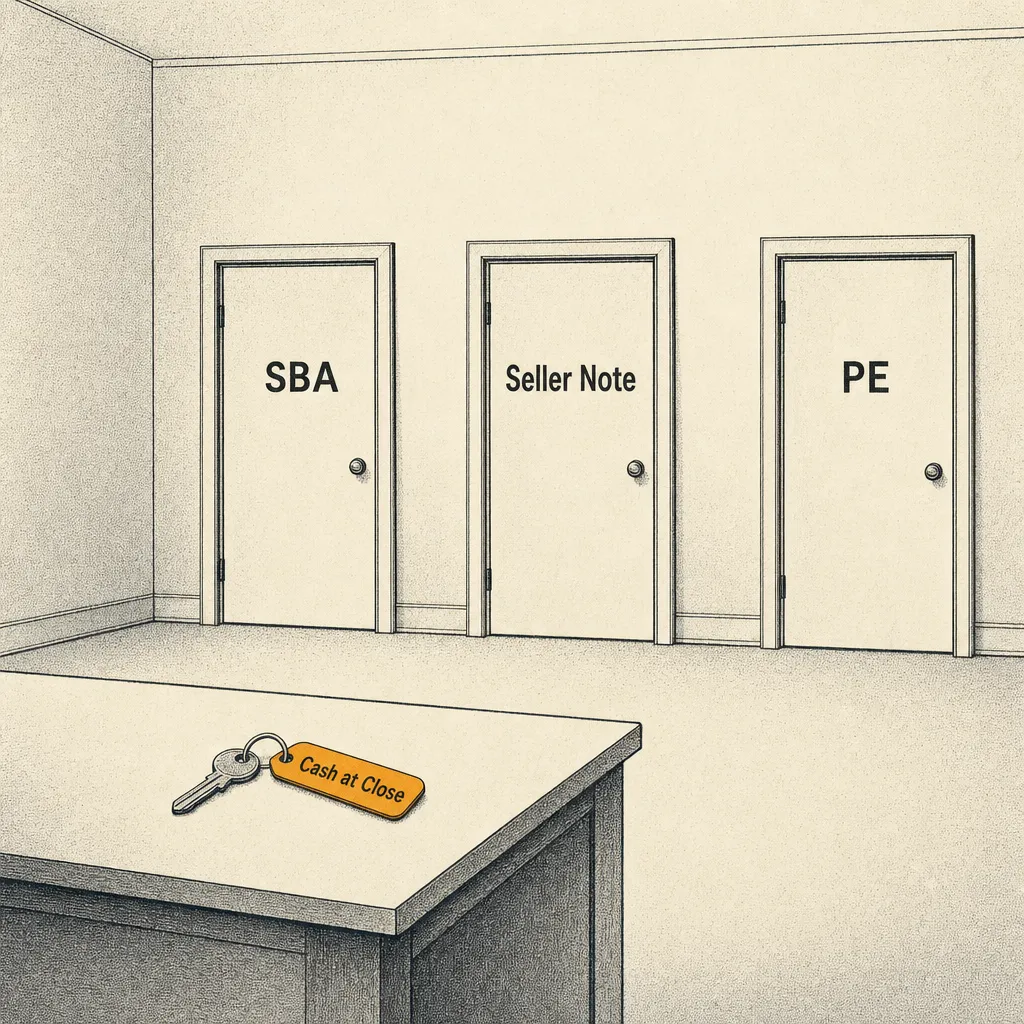
A first-time insurance agency buyer has three paths to fund an acquisition. An SBA 7(a) loan covers up to 90% of the purchase price with a 10-year term and rates at Prime plus 2 to 2.75% in 2026, per SBA lender guidelines SBA 7(a) Loan for Business Acquisition in 2026. A seller note fills the equity gap when the buyer's cash falls short, sitting on full standby so the SBA lender counts it toward the required injection SBA Loan Rules in 2026. Private equity backing writes a different check entirely: capital without a personal guarantee, but the cost is equity ownership and a five-to-seven-year exit clock. Most first acquisitions blend the SBA 7(a) with a seller note. Get the stack right and the math clears. Get it wrong and you service debt the book cannot carry.
Key Takeaways
- SBA 7(a) loans fund up to $5 million per transaction with 10-year amortization at roughly 10 to 11% interest in 2026; the buyer puts down 10 to 15% in cash equity SBA 7(a) Loan for Business Acquisition in 2026
- Seller notes bridge the equity gap, typically 10 to 20% of purchase price, but must sit on full standby with no payments to the seller for the life of the SBA loan Seller Notes, Earnouts, and SBA
- PE-backed buyers controlled roughly 73% of insurance brokerage acquisitions in 2025, but PE targets platform-grade agencies above $2 million EBITDA, not most first-time buyer deals Insurance Agency M&A Activity Slows
- The standard SBA capital stack is 70 to 80% loan, 10 to 15% buyer cash, and 10 to 20% seller note; earnouts are not permitted inside SBA structures Seller Notes, Earnouts, and SBA
- Book retention above 90% is the single largest multiple driver; below 85% and any financing source will demand a structured earnout or a smaller loan Insurance Agency Financing Options
How does an SBA 7(a) loan actually work for an insurance agency acquisition?
The SBA 7(a) program is the dominant financing vehicle for first-time agency buyers acquiring books under $5 million. The SBA guarantees 75 to 85% of the loan to the lender, which is what makes a bank willing to fund a commission-stream asset with limited hard collateral 7(a) loans.
The 2026 structure: a $5 million cap, 10-year amortization, variable rate at Prime plus 2 to 2.75 percentage points, and a personal guarantee from any owner holding 20% or more SBA 7(a) Loan for Business Acquisition in 2026. The buyer must inject at least 10% equity. Half of that must be cash. The other half can be a seller note on full standby for the life of the SBA loan SBA Loan Rules in 2026.
The approval timeline runs 60 to 120 days, and the lender underwrites to a DSCR of 1.15x or higher SBA 7(a) Loan for Business Acquisition in 2026.
One practical constraint: most SBA lenders will not finance more than roughly $1.2 million for an insurance agency purchase because the business carries limited physical assets Insurance Agency Financing Options. Commission streams are not hard collateral. The gap between the $5 million program cap and the $1.2 million practical ceiling is where deal structuring gets real.
As of July 4, 2026, a borrower can access up to $5 million in 7(a) and $5 million in 504 independently for a combined $10 million SBA Loan Rules in 2026.
What does a seller note look like and when does it make sense?
A seller note is a portion of the purchase price the seller finances rather than taking as cash at close. In insurance agency acquisitions, seller notes typically run 10 to 20% of the total price and carry 5 to 8% interest over 3 to 5 years Seller Notes, Earnouts, and SBA.
For a first-time buyer, the seller note closes the equity gap and aligns the seller with the transition. If the seller still has $100,000 in the deal on a 5-year note, that seller has real incentive to make sure carrier appointments transfer and producers stay.
The tradeoff is the standby requirement. To count toward the SBA equity injection, the seller note must sit on full standby for the entire term of the SBA loan, zero principal and zero interest payments until the SBA loan is paid off SBA Loan Rules in 2026. For a seller who wants income immediately, this is a hard conversation. For a buyer, it is the mechanism that makes the deal fundable.
Outside an SBA structure, a seller note can carry performance-based features. But inside an SBA deal, the purchase price must be fixed at closing Seller Notes, Earnouts, and SBA. A true earnout, where a portion of the price is contingent on post-close performance, is not permitted in an SBA 7(a) transaction. If retention is the concern, structure a lower base price with a performance-triggered bonus outside the SBA stack.
When does private equity backing become viable for a first acquisition?
Private equity-backed buyers controlled 73% of insurance brokerage M&A transactions in 2025, per OPTIS Partners data Insurance Agency M&A Activity Slows. But PE operates at a scale unrelated to a first-time buyer acquiring a single book.
PE-backed platforms target agencies with $2 million or more in EBITDA, commercial lines mix above 60%, and book retention at 90% or higher Buying an Insurance Agency: The 2026 Buyer's Playbook. The first-time buyer acquiring a $750,000 revenue captive book is not competing with PE.
Where PE does intersect is the search fund model. A search fund raises $500,000 to $1.5 million from investors, layers SBA debt, and gives the operator a salary, carried equity, and a board expecting a liquidity event in 5 to 7 years. This is a career path, not a financing tactic. For a captive agent who has spent a decade building a book inside one carrier's ecosystem, PE is almost never the first acquisition vehicle: the capital is there, but the control tradeoff is permanent. The SBA plus seller note path preserves ownership.
How do you calculate whether the debt service actually clears?
The number that kills more first acquisitions than any other is the monthly debt payment against book's actual cash flow. A $1 million SBA loan at 11% over 10 years carries a monthly payment of roughly $13,775. Before the buyer takes a dollar of income, that payment is due.
The lender underwrites to a DSCR of 1.15x or better, meaning net operating income must be at least 1.15 times annual debt payments SBA 7(a) Loan for Business Acquisition in 2026. On a $1 million loan, that means $190,000 in annual net income to clear the minimum. Practitioners target 2.0x for comfort.
The captive-specific math tightens further. The captive agent's book is 100% one carrier. If that carrier changes the commission schedule, tightens underwriting, or rates above market, the entire revenue stream compresses. A 10% rate-driven non-renewal wave drops cash flow by roughly 10% with no offsetting appointment. An independent agency with eight appointments can shift volume. A captive book cannot.
This is the diligence lever for a captive first-time buyer. Before signing a term sheet, model debt service at three retention scenarios: 90%, 85%, and 80%. If DSCR drops below 1.0 at the 85% scenario, the deal needs a lower price, a longer seller standby, or more cash equity.
Frequently Asked Questions
How much cash does a first-time buyer actually need to close?
At least 5% of the total project cost must be the buyer's own cash, and 10% total equity injection is required SBA Loan Rules in 2026. On a $1 million acquisition, $50,000 minimum cash plus a $50,000 seller note on standby. In practice, lenders impose overlays above the SBA minimum. Plan for $150,000 to $200,000 in available cash on a $1 million deal.
Can I combine an SBA 7(a) loan with a seller note?
Yes. The most common first-time buyer capital stack is 70 to 80% SBA 7(a), 10 to 15% buyer cash, and 10 to 20% seller note on standby Seller Notes, Earnouts, and SBA. The seller note portion counted toward the equity injection must be on full standby.
Why are most SBA lenders hesitant to fund insurance agency acquisitions above $1.2 million?
Insurance agencies carry limited physical collateral. When the loan exceeds roughly $1.2 million, most lenders demand additional collateral, typically real estate or a personal guarantee secured by real property Insurance Agency Financing Options. A buyer who owns a home with equity has more borrowing capacity than a renter with the same cash.
Does a first-time captive agent buyer face any different financing constraints than an independent?
Yes. The captive book is 100% one carrier appointment, meaning the lender is underwriting a single-carrier concentration risk. An independent agency with multiple appointments diversifies that risk. A captive buyer may need a larger equity injection or a longer seller standby to offset it.
Can I use an earnout instead of a seller note in an SBA deal?
No. The SBA 7(a) program requires the purchase price to be fixed at closing Seller Notes, Earnouts, and SBA. Structure a lower base price with a retention bonus outside the SBA stack, or negotiate an indemnity escrow funded from the seller's cash-at-close proceeds.
What is the operator's take on financing a first acquisition?
The SBA 7(a) plus seller note stack is the highest-probability path for a first-time captive agency buyer. PE backing looks like free money until you read the control provisions, and a pure cash deal at current rates burns equity that could fund the second acquisition. The math that matters is the monthly debt payment against the book's renewal cash flow at 85% retention. If that number clears at 1.5x DSCR or better, the stack works. If it does not, the deal is the wrong price or the wrong book. Push equity, not price.
Sources
- SBA 7(a) Loan for Business Acquisition 2026, CT Acquisitions
- SBA Loan Rules 2026, Security Bank & Trust
- Seller Notes, Earnouts, and SBA, ClearlyAcquired
- Insurance Agency Financing Options, Agency Brokerage
- Insurance Agency M&A Activity Slows, Risk & Insurance
- 7(a) Loans, U.S. Small Business Administration
Related Reading
Calculate Your Deal Structure
Get Started →Related reading
Written by licensed property and casualty agency operators on the Insurance Dudes M&A Desk. Insurance Agency Trader is US-based, serving independent and captive agency owners across the United States.
Editorial process: every post is reviewed against our published valuation math and current market data before it ships, and updated when the numbers move. Corrections: email craig@insuranceagencytrader.com and we will fix errors promptly.