What a $4M Agency Sells For in 2026 (If You Even Can)
U.S. brokerage M&A delivered 241 deals through May 2026. Private capital drives 70% of deals. Here is who is buying and what multiples clear heading into Q3.
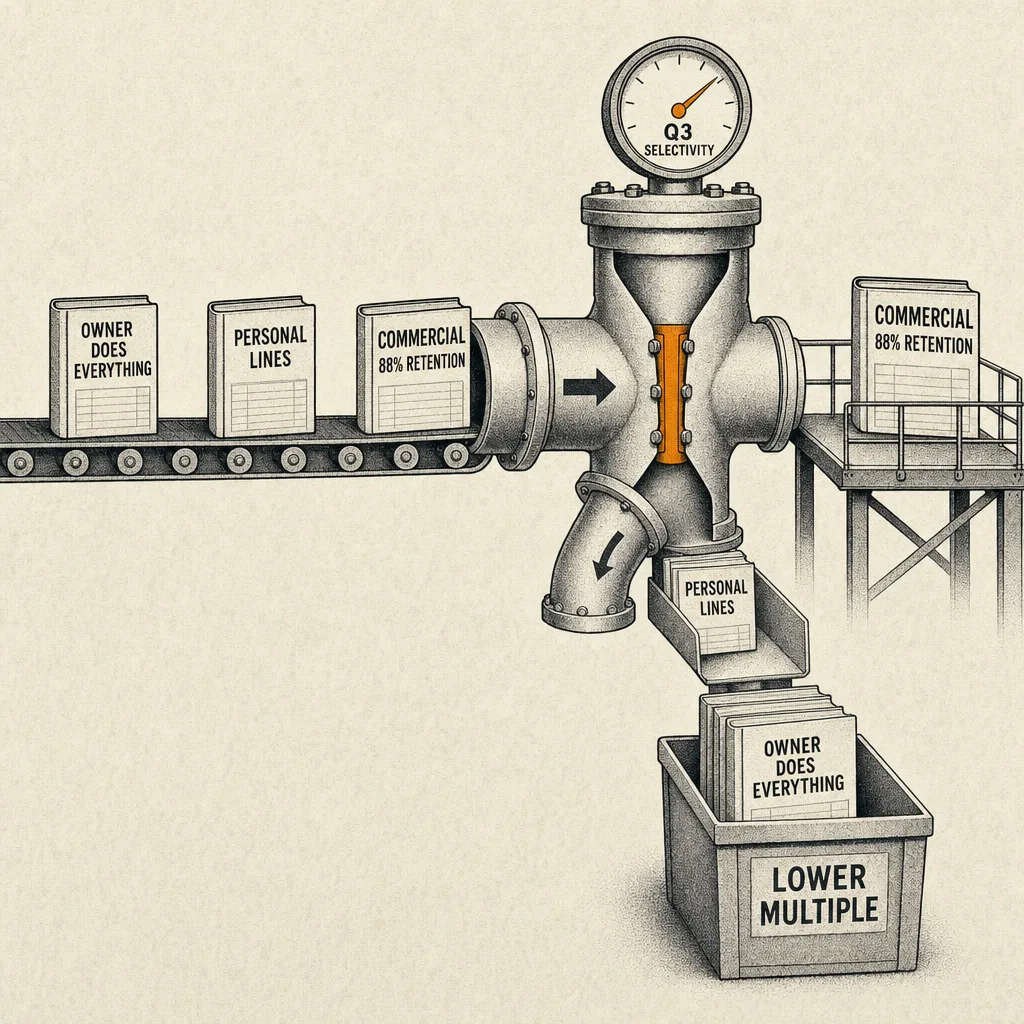
U.S. insurance brokerage M&A delivered 241 announced deals through May 2026, down 5% from last year but still above historical averages. Private capital buyers drove 70% of all transactions. Quality commercial agencies with organic growth command strong multiples while rate-dependent personal-lines books face a tougher valuation environment heading into Q3.
What is driving deal volume heading into Q3 2026?
The headline is that deal flow is holding. The PwC 2026 midyear insurance deals outlook recorded $29.6 billion in announced deal value across 191 disclosed transactions for the six months ending May 31, 2026, according to PwC. That is a modest dip from the prior six-month window but far from a pullback.
What changed underwater is the composition. Megadeals are doing the heavy lifting on dollar volume. Corebridge and Equitable announced a $22 billion merger in March 2026. Willis Towers Watson agreed to acquire Newfront for $1.45 billion. These platform-sized deals concentrate total dollar figures while the mid-market and small-agency pipelines run on their own track.
For the Main Street owner, megadeal dollar volume is theater. The number that matters is the transaction count, which MarshBerry tracks at 241 through May. That is the same buyer appetite that touches Main Street agencies. And the appetite is still there.
The macro pressures on deal flow include elevated borrowing costs, geopolitical volatility, and energy price pressure through mid-2026. MarshBerry characterizes the environment as "resilient but recalibrating," a consolidation story driven by abundant capital and strategic necessity, but increasingly defined by selectivity, discipline, and long-term value creation, per MarshBerry.
Who is buying independent agencies in 2026?
The buyer composition in 2026 splits into three lanes.
Private capital-backed buyers remain the overwhelming force. MarshBerry reports 170 of 241 deals through May, or 70.5%, were PE-backed. Independent brokers accounted for just 23 transactions, 9.5% of the market. Publicly traded insurance brokers were buyers in 22 deals. Banks and thrifts made five purchases.
The concentration at the top is striking. The top ten buyers consumed 51.5% of all announced deals through May. BroadStreet Partners, Inszone Insurance Services, and ALKEME alone took 30.7%. ALKEME completed eight acquisitions in Q2 2026 alone, per MarshBerry, expanding into commercial, personal lines, Medicare benefits, and environmental lines simultaneously.
Specialty intermediaries as targets represented 46 deals, or 19.1% of all transactions, and MarshBerry notes this is a continued uptick in a seller segment that has been in low supply for several years.
Daily M&A headlines from the Insurance Journal mergers feed confirm this pace: Sequel Insurance Agencies acquired a Texas-based independent agency on July 8, Union Bay Acquisition picked up a Michigan agency in June, and SIAA-powered platforms continue rolling up regional independents. The aggregator playbook has not changed. PE-backed platforms buy agencies, fold them into a larger entity, cross-sell across the combined book, and exit in 5 to 7 years. What has changed is the selectivity. PwC notes that PE sponsors are increasingly focused on organic growth quality, the strength of technology infrastructure, and the maturity of internal controls required to support an eventual IPO or platform sale, per PwC.
What do multiples look like in the current market?
Multiples vary by size, book composition, and buyer type. The ranges have compressed from the 2021-2022 peak but stabilized at historically strong levels.
Small agencies under $2 million in commission revenue transact at roughly 1.5x to 2.5x commission revenue, based on Reagan Consulting and OPTIS Partners tracking across the 2024 to Q2 2026 window, per CT Acquisitions.
Lower middle market brokerages with $2 million to $10 million in revenue and $750,000 to $2 million in adjusted EBITDA transact at approximately 7x to 9x adjusted EBITDA, per MarshBerry and OPTIS Partners data compiled by CT Acquisitions.
AgencyEquity frames the Main Street reality more directly. Most well-managed independent agencies are selling for roughly 1.75x to 2.5x annual commission revenue. Agencies with heavy commercial books, strong retention, and consistent organic growth clear the top of the band. Declining revenue, owner dependence, or weak retention push toward the bottom, per AgencyEquity. For a deeper look at the valuation drivers behind these multiples, see our agency valuation multiples breakdown.
The personal-lines discount is real. Personal-lines-only agencies trade at a 0.5 to 1.0 turn discount to commercial P&C books on adjusted EBITDA, per OPTIS Partners data cited by CT Acquisitions. Employee benefits brokerage books carry a 1.0 to 2.0 turn premium because benefits commissions are stickier and less rate-sensitive than personal-lines premiums, per multiple advisory compilations including Sica Fletcher's Agency M&A Index.
AgencyEquity also surfaces a point often missed in the multiple conversation: the highest offer is not always the best offer. Earn-outs, deferred payments, consulting agreements, and retention incentives can make a larger headline number produce less cash at close than a cleaner structure at a slightly lower multiple.
What shifts are underway in the buyer-seller dynamic?
The market is not static, and three shifts heading into Q3 matter for any owner evaluating timing.
First, organic growth is getting harder to find. PwC notes that premium rate increases across most product lines have moderated from the elevated levels of 2022 to 2024. Publicly traded brokers are forecasting slower organic growth, which lowers distributor valuations and narrows the valuation arbitrage that has historically supported the roll-up model, per PwC. For a seller, this means the buyer's math works best when your book already has organic growth embedded, not when they have to inject it after close.
Second, AI uncertainty is rattling valuations. Both public and private markets are evaluating whether AI enables new entrants to capture share by delivering brokerage services at a structurally lower cost, or whether incumbents can use AI to improve efficiency and sustain margins. PwC identifies this as a factor actively influencing capital allocation and M&A strategy in the sector.
Third, the buyer pool is broadening at the lower end. AgencyEquity reports that large national consolidators remain active, but more buyers are successful independent agencies looking to expand into neighboring communities, acquire staff, or increase carrier volume through acquisition. These buyers often understand the value of a well-run independent agency because they built one themselves.
How should sellers position for the Q3 pipeline?
The agencies clearing top-of-band multiples in mid-2026 share a profile. Commercial books with 85% or better retention. Owner not embedded in every client relationship. Carrier consent and appointment transfer are clean, so the book moves without a diligence landmine, whether that is one carrier or several. Clean financial records with clearly separated owner discretionary expenses. Consistent organic growth; buyers are paying for growth already on the books, not growth they have to build.
AgencyEquity notes that even modest improvements made two to three years before a sale can have a meaningful impact on final purchase price. The agencies that sell well are the ones that stopped operating like a job and started operating like an asset while the owner was still running it. If you want a starting point for your own number, try our free agency valuation calculator.
Frequently Asked Questions
How many insurance agency acquisitions happened in 2026 so far?
Through May 31, 2026, there were 241 announced M&A transactions in the U.S. insurance brokerage sector, down 5.1% from 254 at the same point in 2025 but still above historical averages, per MarshBerry.
What multiple can I sell my insurance agency for in 2026?
Small agencies under $2 million in commission revenue sell for roughly 1.5x to 2.5x commission revenue. Lower middle market brokerages with $2 million to $10 million revenue transact at 7x to 9x adjusted EBITDA, per MarshBerry and OPTIS Partners data. Commercial books with strong retention clear the upper band.
Who is buying insurance agencies right now?
Private capital-backed buyers are the dominant force, accounting for 70.5% of all deals through May 2026. The top three buyers, BroadStreet Partners, Inszone, and ALKEME, accounted for 30.7% of all transactions, per MarshBerry. Independent brokers represented 9.5% of buy-side activity.
Is now a good time to sell my insurance agency?
Competition for quality independent agencies remains healthy, with more qualified buyers than agencies available for sale. Strong commercial books with higher retention, diversified carrier relationships, and consistent growth continue to attract premium offers, per AgencyEquity.
How do earnouts work in an agency sale?
The total consideration is often split between cash at close and an earnout contingent on retention and revenue targets over a 1 to 3 year period. An offer with a higher headline price but a larger earnout may produce less cash at close than a cleaner structure at a slightly lower multiple, per AgencyEquity. Rollover equity into the buyer's holding company shares is also common, typically 20% to 40% of consideration.
Sources
- MarshBerry, "Insurance Brokerage M&A Remains Resilient But With Signs Of Recalibration," 2026. https://www.marshberry.com/resource/insurance-brokerage-ma-remains-resilient-but-with-signs-of-recalibration/
- PwC, "Insurance: US Deals 2026 Midyear Outlook," 2026. https://www.pwc.com/us/en/industries/financial-services/library/insurance-deals-outlook.html
- CT Acquisitions, "Insurance Agency and Broker M&A Multiples Report 2026," July 1, 2026. https://ctacquisitions.com/guides/insurance-agency-ma-multiples-2026/
- AgencyEquity, "What Is Your Insurance Agency Worth in Today's M&A Market," 2026. https://www.agencyequity.com/agency-management/what-is-your-insurance-agency-worth-in-todays-ma-market
- Insurance Journal, "Mergers & Acquisitions," July 2026. https://www.insurancejournal.com/mergers/
Related Reading
Calculate Your Agency Value
Get Started →Related reading
Written by licensed property and casualty agency operators on the Insurance Dudes M&A Desk. Insurance Agency Trader is US-based, serving independent and captive agency owners across the United States.
Editorial process: every post is reviewed against our published valuation math and current market data before it ships, and updated when the numbers move. Corrections: email craig@insuranceagencytrader.com and we will fix errors promptly.