Farmers.com Captive Agency Indicators: The Five to Watch
Five indicators determine a Farmers captive agency's value: retention rate, loss ratio, premium growth, policy count trend, and line-of-business mix in 2026.
A Farmers captive agency's health comes down to five indicators: policy retention rate, loss ratio, new business premium growth, policy-count trend, and line-of-business mix. Contract Value pays roughly one year of renewal commissions. An open-market sale can fetch more, but only with strong retention and a clean loss ratio.
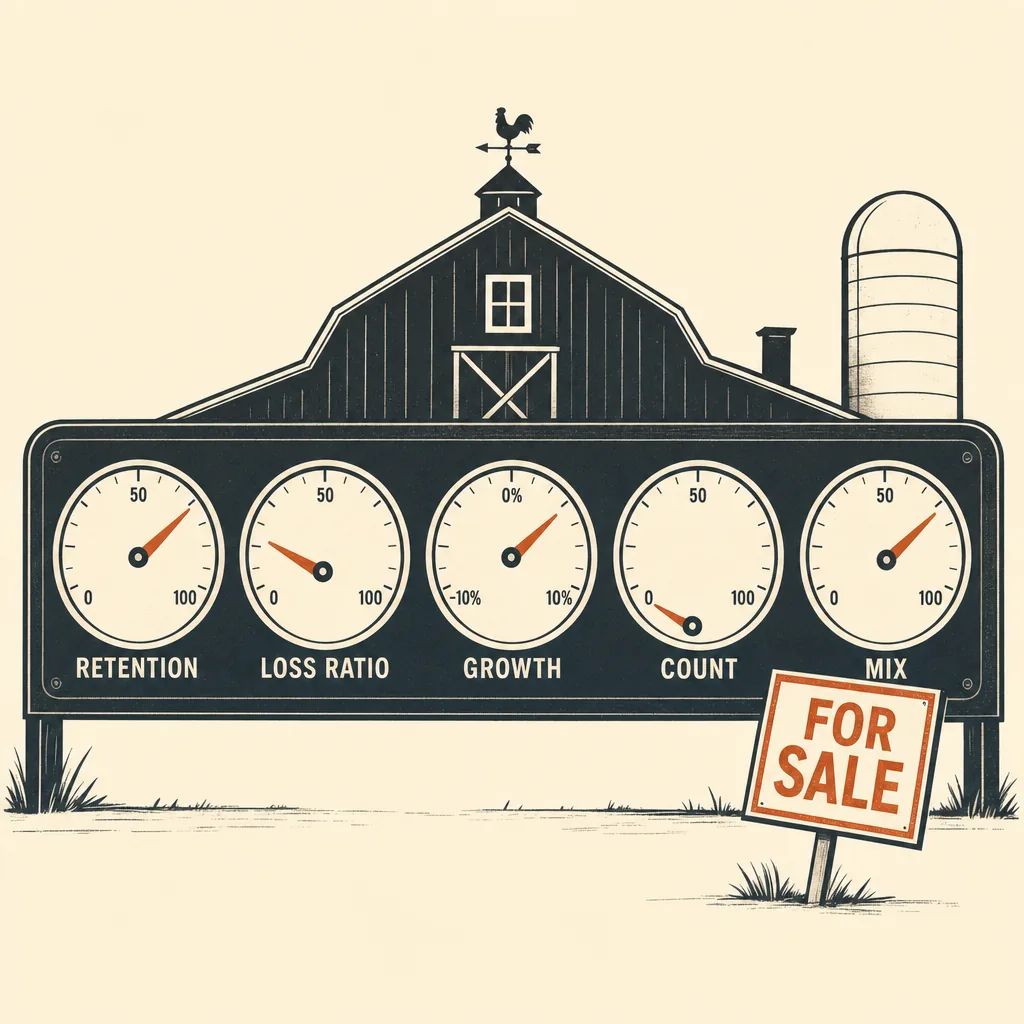
Most Farmers agents do not know what their agency is actually worth. They know their commission check. They know their staff count. They know roughly how many policies are on the books. But when a District Manager mentions Contract Value, or a buyer asks about loss ratio, or a broker tosses out a multiple, the numbers stop making sense. This post walks through the five indicators that actually move the needle, whether evaluating your own book, preparing for an exit, or looking at an acquisition.
TL;DR
- Farmers agents have two exit paths: Contract Value (roughly one year of renewal commissions) or open-market sale under the newer agency agreement. Market value is almost always higher, but only if the numbers support it.
- The five core indicators are policy retention rate, loss ratio, new business premium trend, policy-count trajectory, and line-of-business mix.
- Retention above 90 percent is the single biggest value driver. Below 85 percent, both Contract Value and market value drop sharply.
- Loss ratio below the carrier's regional benchmark is the difference between a bonus and a haircut at exit.
- A shrinking policy count offsets even strong premium growth. Buyers see it. So does Farmers.
What five indicators actually determine a Farmers agency's health?
Forget vanity metrics. The five indicators that move agency value, whether for Contract Value, an open-market sale, or your own internal dashboard, are the ones that show up in every buyer's model.
1. Policy retention rate. This is policies renewed divided by policies up for renewal. The industry average for P&C agencies sits around 84 to 85 percent, with top-performing agencies at 93 to 95 percent retention, per QuoteSweep's 2026 valuation guide. Every percentage point above 90 compounds into significantly higher lifetime client value. A buyer applying a multiple to your book discounts any agency below 88 percent retention directly from the offer. At the carrier level, Decerto's 2026 agent KPI analysis identifies the agent-level renewal rate as the single best leading indicator of whether a producer stays with the carrier.
2. Loss ratio. This is incurred losses divided by earned premium on your book. Farmers tracks this by agent and uses it in the Contract Value calculation, with a profitability bonus for clean books. NAIC's 2024 full-year results put the P&C industry net loss ratio at 71.2 percent. If your book runs hotter than the carrier's regional benchmark, two things happen: your Contract Value shrinks, and open-market buyers discount the offer. A clean loss ratio signals underwriting discipline. A deteriorating one signals a book that costs the carrier money.
3. New business premium growth. Total new written premium per quarter, tracked year over year. A book in decline, even with strong retention, is a shrinking asset. Without new business, even strong retention cannot protect against market shifts or natural attrition. A flat or declining new-business line is the first signal a book is contracting, regardless of what the retention number says. A Farmers agency that wrote 180,000 dollars in new premium last year and 120,000 this year is contracting at 33 percent. Buyers price that trajectory, not just the current book size. Agents tracking this pattern should run the numbers through a valuation tool before the trend becomes the story.
4. Policy-count trend. Premium growth can mask policy-count decline if average premium per policy is rising due to rate increases. An agency whose total premium is flat but policy count is down 8 percent year over year has a retention problem that rate hikes are papering over. This indicator matters because Farmers Contract Value is based on renewal commissions, not total premium. Same premium, fewer policies, fewer renewals next year.
5. Line-of-business mix. Personal auto, home, life, and commercial all carry different retention profiles and commission rates. Captive renewal commissions generally run lower than independent, and personal auto in particular faces more aggressive rate-shopping from direct writers than home or life lines. A Farmers agency that is 90 percent personal auto faces more rate-shopping churn than one with a diversified mix. Buyers examining a captive book discount heavy personal auto concentration, particularly in states where direct writers are aggressive on rate. For agents considering whether the captive model still serves them, the Farmers agent exit guide walks through the decision framework.
How does Farmers Contract Value actually work?
Farmers offers agency owners two exit paths. The first is Contract Value, a formula-driven buyout defined in the agent appointment agreement. Per the Farmers FAQ page, agency owners can take advantage of the Contract Value provision of their agent appointment agreement when the time is right. AgencyEquity notes that Contract Value in most cases calculates to about a year's worth of commissions payable over time, with an additional bonus for underwriting profitability.
Contract Value is based on renewal commissions, not new business. That distinction is load-bearing. An agent who wrote heavily in the final year thinking it would boost the exit number discovers that only the renewing book counts. The profitability bonus is what makes loss ratio one of the five core indicators stated above: a clean book earns a bonus; a hot book takes a discount.
The second path, available under the newer Farmers agency agreement, is selling on the open market to a qualified buyer. Market value is expected to be significantly higher than Contract Value, per AgencyEquity. Buyers must meet Farmers qualification standards, and the approved-buyer pool is smaller than for independent agencies.
How do these indicators compare to independent agency valuation?
Independent agencies are valued on revenue or EBITDA multiples. CT Acquisitions' 2026 guide places personal lines P&C agencies under 1 million dollars in revenue at 1.5x to 2.0x revenue or 5x to 7x EBITDA. Commercial-heavy independents in the 2 to 15 million dollar range trade at 2.0x to 3.0x revenue or 7x to 9x EBITDA.
Farmers captive agencies do not trade on these multiples in the same way because the carrier retains ownership of the book. What a buyer acquires is the service and commission rights under the Farmers appointment, subject to carrier approval. This structural difference means the same retention rate at a captive agency produces a lower market value than at an independent agency with the same book metrics, because the independent agent owns the book outright and controls carrier relationships.
The AgencyEquity captive-to-independent transition guide confirms that in many captive arrangements, the carrier owns the book of business or maintains significant control over it, while independent agents typically own their business books outright and can sell to a buyer of their choice.
What does a healthy Farmers agency look like in 2026?
Pull these five numbers on your own book and compare:
- Retention rate: 90 percent or above is strong. 85 to 89 percent is average. Below 85 percent, fix retention before talking to a buyer or counting on a full Contract Value bonus.
- Loss ratio: Below your District's benchmark. Farmers publishes regional loss ratio averages internally. If you are above the regional average by more than five points, expect a profitability discount.
- New business premium: Growing year over year, or at minimum flat. A declining new business line signals a producer pipeline problem that the next owner inherits.
- Policy count: Flat or growing. A declining policy count is the canary. It means rate increases are masking an outflow of households.
- Line mix: At least 20 percent of premium from non-auto lines. Home, life, and commercial provide retention ballast against personal auto rate-shopping.
If four of five indicators are trending the wrong direction, the Contract Value math still pays something. But the open-market path closes quickly. Buyers and brokers look at the same five numbers. So does Farmers. For the broader context on agent departures, see why Farmers agents are leaving in 2026.
Frequently Asked Questions
What is the Farmers Contract Value calculation based on?
Contract Value is based on renewal commissions from the prior year, not new business. An additional bonus is applied for underwriting profitability on the book. The total is typically payable over time rather than in a lump sum.
Can a Farmers agent sell to any buyer?
No. Buyers must meet Farmers qualification standards under the agency agreement. The buyer pool is smaller than for independent agencies. An acceptable buyer typically holds the required licenses and passes Farmers internal review.
How much more is open-market value than Contract Value?
Market value varies by book quality. A book with 90 percent retention and a clean loss ratio commands the highest premium. A book with deteriorating metrics may not beat Contract Value by enough to justify the transaction cost.
Do loss ratio and retention matter for Contract Value?
Yes. The profitability bonus in the Contract Value formula is tied to underwriting results. A loss ratio above the carrier benchmark reduces or eliminates the bonus. Retention indirectly affects Contract Value because only renewing policies count toward the commission base.
What is the single most important indicator for a Farmers agency's value?
Policy retention rate. It drives both the Contract Value commission base and the multiple a buyer applies on the open market. A 5-point retention improvement from 85 to 90 percent can meaningfully increase lifetime client value, per QuoteSweep.
What should a Farmers agent do with these indicators?
The five indicators are straightforward. Every District Manager tracks them. The gap is not data. It is that most agents never stack their own numbers against what a buyer or the carrier uses to calculate the exit number. Do that once a quarter. If retention is below 85 or policy count drops three quarters in a row, fix operations before you need the exit. The Contract Value formula does not care about your years of service. It cares about renewal commissions and loss ratio from the last twelve months. Run the book like you are selling it next year, and the number will be there when you need it.
Sources
- NAIC, "U.S. Property & Casualty and Title Insurance Industries - 2024 Full Year Results," 2025. Link
- CT Acquisitions, "Insurance Agency Business Valuation in 2026," June 2026. Link
- QuoteSweep, "Insurance Agency Valuation: 2.5-3.2x Multiples," March 2026. Link
- Decerto, "Insurance Agent KPIs: A 2026 Real-Time Dashboard Playbook," May 2026. Link
- AgencyEquity, "Guide to Transitioning from a Captive to an Independent Insurance Agency," May 2026. Link
- AgencyEquity, "Farmers Insurance Agencies to be Sold on the Open Market," 2013. Link
- Farmers Insurance, "Frequently Asked Questions - How to Get Started." Link
Related Reading
Calculate Your Agency Value
Get Started →Related reading
Written by licensed property and casualty agency operators on the Insurance Dudes M&A Desk. Insurance Agency Trader is US-based, serving independent and captive agency owners across the United States.
Editorial process: every post is reviewed against our published valuation math and current market data before it ships, and updated when the numbers move. Corrections: email craig@insuranceagencytrader.com and we will fix errors promptly.