Farmers Agent Exit Guide: What Corporate Won't Say
Farmers agents are leaving in record numbers in 2026. How the 90-day notice works, what contract value actually pays, and where the non-compete really bites.
Farmers agents are walking in waves because the math stopped working: rate uncompetitiveness, bonus thresholds rebuilt to be unhittable, and 20 percent commission cuts. The 90-day notice is real, the non-compete is narrower than rumored, and contract value rarely matches what an independent book would fetch.
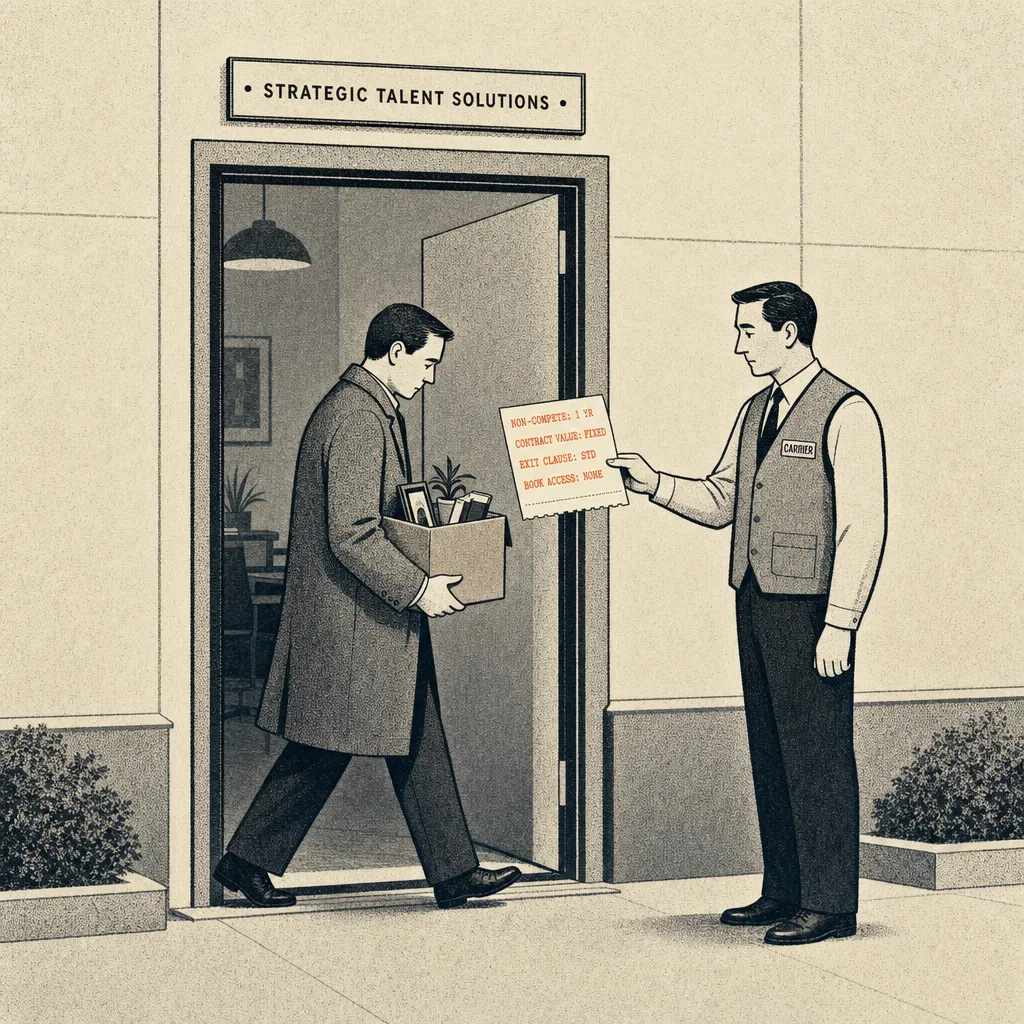
I've watched more Farmers agents leave in the last three years than in the previous decade combined. The commission cuts, the impossible bonus structures, the rates that haven't been competitive since the late 2000s, it's all adding up. And the agents who are leaving aren't the failures. They're the ones who did the math.
If you're a Farmers agent thinking about walking away, here's what actually happens. Not the corporate version. The real version.
How Does the Farmers 90-Day Notice Period Actually Work?
When you resign from Farmers, you're required to give 90 days notice according to the standard Farmers agent agreement (Pacific Crest Services). This isn't optional, it's in your contract. During those 90 days, you'll still receive your commissions and you're still technically able to sell. You'll also still pay for your Farmers E&O insurance during this period.
The purpose of the 90-day window is to smooth the transition. Farmers will move your policies to another agent in your district. Agents report that the subsidy reconciliation process during the 90-day notice period is often less financially painful than expected, but the specifics depend on your individual contract terms. Review your agreement carefully and consult with a captive contract attorney before giving notice.
Use those 90 days wisely. You can't solicit your Farmers customers yet, but you can be getting carrier appointments, setting up your AMS, securing your own E&O and building the infrastructure for your independent agency.
Is the Farmers Non-Compete Really Enforceable Against You?
The Farmers non-compete clause applies to the customers you accumulated while at Farmers. That's it. For one year, you can't solicit those specific clients. You are not prohibited from selling insurance. You're not banned from your geographic area. You're restricted from directly going after the people in your Farmers book for twelve months.
Every other prospect, every new lead, every referral from someone who was never your Farmers customer, those are yours from day one.
I've talked to agents who spent years afraid of the non-compete, imagining it was some kind of career death sentence. It's not. It's a speed bump and twelve months goes fast when you're building something you actually own.
What Is Your Farmers Contract Value Actually Worth in 2026?
Here's where it gets painful. Your contract value, what many agents think of as their retirement cushion or nest egg, is directly tied to your commission structure. When Farmers slashed commissions by 20 percent or more, your contract value decreased by the same percentage. Farmers has been cutting base commission rates "for most products" while restructuring its agent distribution model. Agent reviews on Indeed describe "commissions reduced to the point of theft."
One industry professional who works with transitioning Farmers agents put it bluntly: after twenty years of dedication, agents are discovering they'll receive 30 percent less than expected when they leave. Your loyalty doesn't get grandfathered. The contract value just shrinks.
An agent who had this experience described using his contract value to cover about 18 months of living expenses while rebuilding as an independent. That's realistic. It's not comfortable, but it's a funded transition if you plan for it.
Why Did the Farmers Bonus Structure Stop Working for Agents?
Agents describe the Farmers bonus structure as requiring near-perfect cross-sell metrics across multiple product lines, home, auto, life and umbrella, on a quarterly basis. Agents report that missing targets with even a single client can jeopardize the entire quarterly bonus.
The practical impact, as agents describe it: a twenty-year-old client who just needs liability-only auto insurance and doesn't own a home can cost you your entire quarterly bonus because they don't need the other products.
Agents we've spoken with describe this structure as extremely difficult to maintain consistently. It's not about rewarding production, it's about creating a perpetual carrot that stays just out of reach. When you combine that with 20 percent commission cuts and agents reporting rising marketing costs, the economics simply don't work for most agents anymore.
What Is the Close-Ratio Problem Costing Farmers Agents?
A veteran Farmers agent admitted his close ratio on auto insurance never got above 10 percent. He was being generous with that number, he said and anyone familiar with the real data would agree.
Ten percent means you're failing to help nine out of every ten people who walk into your office willing to spend money. Not because you're bad at your job, because Farmers' rates aren't competitive in your market and you have exactly one option to offer. While no single industry-wide study publishes captive vs. independent close ratios, these figures are consistently reported across independent agency networks like SIAA and Smart Choice and corroborated by agents who have made the transition, with the differential attributed to single-carrier pricing constraints versus multi-carrier market access.
That same agent went independent and reported selling more in his first year than he had in five years with Farmers. The difference wasn't talent or effort. It was having fifteen carriers instead of one. The close ratio gap between captive and independent agents is the single biggest driver of this outcome.
What Pattern Are Departing Farmers Agents Refusing to Name Out Loud?
I did some research on Farmers agent tenure across several states. Agent tenure data suggests significant churn within the Farmers system, industry observers and agent associations report that a substantial portion of Farmers agents don't make it past year three. Farmers has also been restructuring its operations, including rebuilding its East region under a district manager model, moves that have further destabilized the agent channel.
This isn't a problem with agents. It's a problem with the model. When your rates aren't competitive, your commission structure is getting cut, your bonus requires impossible cross-sell ratios and your carrier opens call centers to compete with you, then closes them overnight with no warning, the model is telling you something.
Agents in online forums and industry discussions have described mass departures from individual districts following the commission restructuring, a pattern that points to structural dissatisfaction rather than individual decisions.
What Does the Independent Side Actually Look Like After You Leave?
A former Farmers agent who made the jump said something that stuck with me: "If you would like to go independent, you will find you'll love insurance again as you control what you do. No one else does."
That's not marketing copy. That's a human being describing the experience of going from a system designed to extract maximum productivity with minimum compensation to a business where your effort directly builds your own asset.
Your book at Farmers? You own it on paper, but you're constrained in who you can sell to, what you can sell, when you can sell it and what happens when you leave. That's not ownership. That's a leash with a nameplate which is exactly the distinction we draw in You Own Your Book, Not Your Business.
The agents who leave describe a period of discomfort, three to six months of lower income, new systems, unfamiliar carriers, followed by a clarity they hadn't felt in years. They're quoting more products, closing at higher rates and building something that'll be valued at actual enterprise multiples when they're ready to sell.
Your district manager will tell you the grass isn't greener. And technically, they're right, it's not greener. It's a completely different color, because it's a completely different business.
"The transition from captive to independent is a financing event as much as it's a business decision. Agents who plan for 12 to 18 months of income replacement, using contract value, SBA financing or network support, make the transition successfully. Those who don't plan for the cash flow gap are the ones who struggle.", Sean Kenny, SIAA (Insurance Thought Leadership: Succession Planning)
For the legal side of the decision, see our guide to captive agent non-compete clauses.
Frequently Asked Questions
Q: Did Farmers really cut commissions by 20 percent?
A: Farmers reduced base commission rates for most products by more than 20 percent as part of a 2023 restructuring. The cuts hit guaranteed base pay and pushed more compensation into bonus tiers that many agents say are structurally difficult to hit.
Q: How is my Farmers contract value calculated?
A: Contract value is a formula tied to your commission history and production, not market value. After the base commission cuts, the inputs to the formula dropped which is one reason agents working through transition planning report payouts below what they had previously projected.
Q: How long is the non-compete after I leave Farmers?
A: Farmers agent agreements typically include a one-year non-solicitation provision post-termination, paired with a 90-day notice period. Enforceability varies by state, most agents who get in trouble do so by proactively soliciting former clients during that window, not by working as an independent agent.
Q: Do I have to give Farmers 90 days' notice?
A: Yes, the standard Farmers agent agreement requires 90 days' notice of resignation. During that window you keep servicing the book and paying E&O and the clock isn't negotiable, it's a contract term.
Q: Is my captive carrier next?
A: Nobody can predict specific carrier decisions, but the industry direction is clearly toward expanded independent distribution, Nationwide already transitioned and peer carriers have been testing hybrid models. Exit planning on your own timeline beats reacting to a carrier announcement. See why Farmers agents are leaving in 2026.
Sources & References
- The Insurer, Farmers Commission Rate Cuts:
- Indeed, Farmers Insurance Agency Owner Reviews: https://www.indeed.com/cmp/Farmers-Insurance-Group/reviews?fjobtitle=Agency+Owner&ftopic=paybenefits
- Live Insurance News, Farmers Insurance Rebuilding: https://www.liveinsurancenews.com/farmers-insurance-is-rebuilding/8570566/
- Insurance Thought Leadership, Succession Planning for Agencies: https://www.insurancethoughtleadership.com/agent-broker/succession-planning-agencies
- SBA, Small Business Loans for Agency Financing: https://www.sba.gov/funding-programs/loans
- Pacific Crest Services, Captive Agent Contract Exit: https://pacificcrestservices.com/captive-pc-agent-contract-exit/
- SIAA (Strategic Insurance Agency Alliance): https://www.siaa.com
- Smart Choice Agents: https://www.smartchoiceagents.com
- UFAA, Farmers Agent Industry News: https://ufaa.com/Industry-News
Written by licensed property and casualty agency operators on the Insurance Dudes M&A Desk. Insurance Agency Trader is US-based, serving independent and captive agency owners across the United States.
Editorial process: every post is reviewed against our published valuation math and current market data before it ships, and updated when the numbers move. Corrections: email craig@insuranceagencytrader.com and we will fix errors promptly.