Farmers Insurance Commission Structure: A Complete Breakdown
Farmers Insurance commission structure: new business and renewal rates by product line, bonus programs, profit sharing, and captive vs independent agent pay.
Farmers Insurance agents earn commission on every policy sold and renewed, with new business rates of 10% to 20% and renewals at 4% to 12% depending on product line. The structure adds production bonuses, profit-sharing, and a 36-month new-agency bonus. Farmers agents own their commission rights and can sell at exit.
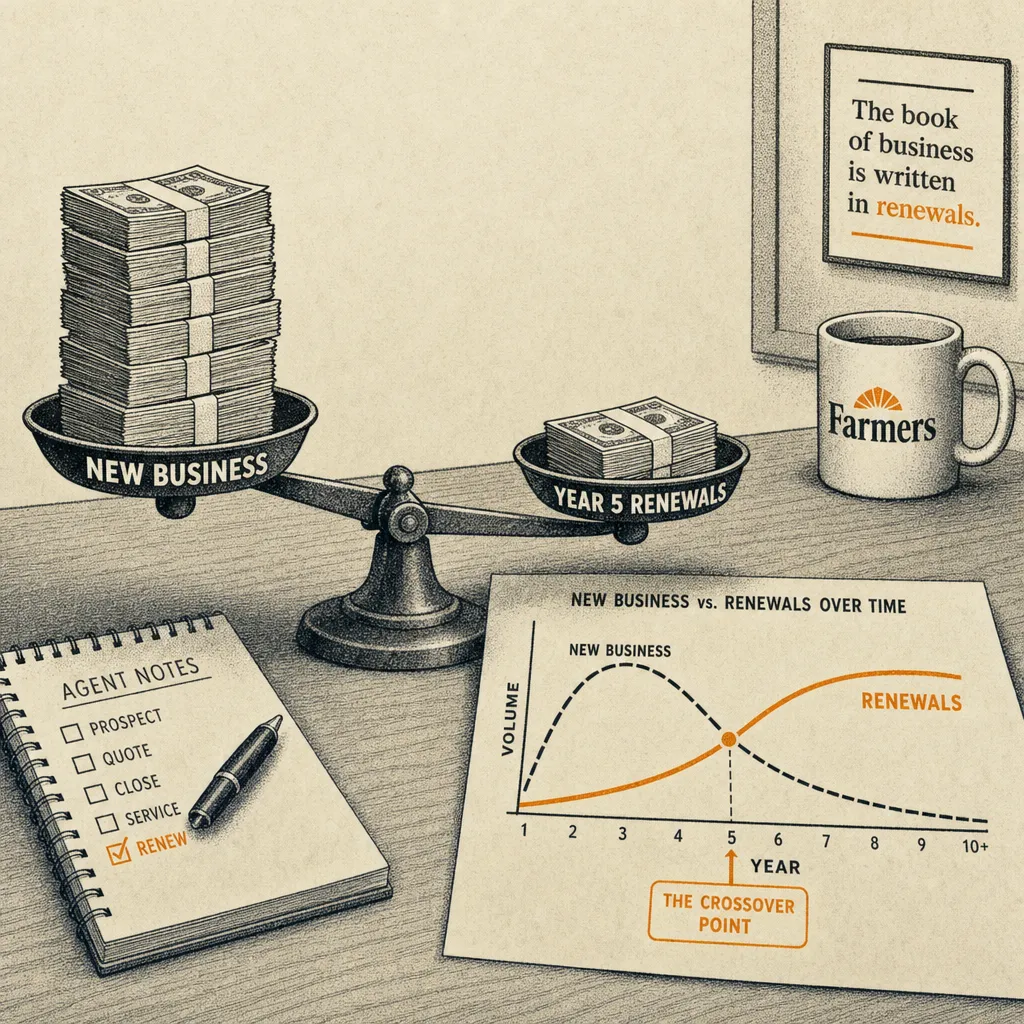
The renewal rate caps the upside on exactly the asset that compounds over a career.
Insurance Dudes M&A Desk
Key Takeaways
- Farmers new business commissions run 10% to 20% of premium depending on product line, with auto at the low end and life/commercial at the high end
- Renewal commissions drop to 4% to 12%, which is where the captive model's structural gap vs independent agents compounds over a career
- New Farmers agency owners can receive up to $96,000 in financial assistance over 36 months plus a 36-month new agency bonus on top of commissions
- Farmers agents are independent contractors who own their commission rights, can sell them on the open market, and qualify for profit-sharing based on book profitability
- The real money is in renewals, which compound year over year, but captive renewal rates run 2-4 points below independent rates, creating a six-figure gap over a 10-year span
A Farmers Insurance agent's income comes from commission on premium, plus bonuses and profit-sharing. The structure rewards production, retention, and book profitability, but specific percentages vary by product line, geography, and production tier. The math works differently at year one than at year ten, and the renewal curve is where the model either compounds or caps out.
How does the Farmers Insurance commission structure work?
Farmers agents are independent contractors with no base salary. Income comes from commission on policies sold and renewed, bonuses for hitting production targets, and profit-sharing tied to loss ratio, as Farmers confirms.
A client pays a premium, the carrier keeps the bulk, and the agency receives a percentage as commission.
Farmers uses individualized commission schedules with no published rate card. Each agent's rates are set based on geography, product mix, production tier, retention history, and overall revenue generated for the carrier, according to Farmers-specific compensation analysis. The three levers are production, retention, and loss ratio. Higher volume and retention move you into higher commission brackets. Lower claims relative to premium collected unlock profit-sharing on top of base commission.
What are Farmers new business commission rates by product line?
Farmers does not publish a standard rate sheet, but the ranges across product lines are well documented. TheMoneyKnowHow and Agentero both report consistent bands:
- Auto insurance: 10% to 15% new business
- Homeowners insurance: 15% to 20% new business
- Life insurance: 40% to 60% first-year commission
- Commercial lines: 10% to 20% new business
- Umbrella policies: 20% or higher The product mix drives the effective blended rate. An agency writing 80% personal auto at 12% commission has a very different revenue profile than one writing 40% home, 20% commercial, and 20% life. Higher-commission lines require more expertise, which is why they pay more.
For context, Firefly Agency reports that captive carriers as a group pay 8% to 12% on new business and 4% to 10% on renewals, while independent carriers pay 12% to 15% new and 10% to 12% renewal. Farmers sits roughly in the middle of the captive band, with homeowners and umbrella rates competitive with independents but auto and renewal rates trailing.
How do Farmers renewal commissions compare to new business?
Renewal commissions run lower than new business across every product line, and this is where the captive model's economics diverge from the independent path.
TheMoneyKnowHow reports Farmers renewal bands of 8% to 12% on auto, 8% to 12% on home, and around 10% on umbrella. Life trails at 3% to 5%. Agentero's broader captive analysis pegs captive renewal rates at 4% to 7% on P&C lines, with Farmers on the higher end of that band.
The gap between new business and renewal creates a predictable income curve. Year one is heavy on new business. By year three, renewals start to out-earn new business. By year five, renewals dominate, as Brightway's compensation analysis confirms.
The difference is the rate itself. An independent agent at 12% renewal on a $100,000 commission book collects $12,000 per year. A Farmers agent at 8% renewal collects $8,000. That $4,000 annual gap, compounded over ten years, is a $40,000 to $60,000 shortfall before accounting for premium growth.
What bonuses and incentives do Farmers agents receive?
Farmers layers three bonus categories on top of base commissions.
New Agency Bonus. New Farmers agency owners are eligible for a 36-month bonus designed to bridge the ramp-up period. The Farmers FAQ confirms "new agency owners may receive up to a 36-month new agency bonus opportunity." This phases down as the renewal book matures.
Production Bonuses. Farmers agents earn additional compensation for hitting production targets, measured in written premium volume and policy count across product lines. Agents who write across multiple product lines, including life insurance, see higher total compensation because life carries a first-year commission of 40% to 60%, per TheMoneyKnowHow.
Profit-Sharing and Contingency Bonuses. Farmers agents participate in profit-sharing based on the loss ratio of their book, per TheMoneyKnowHow. This adds 1% to 3% to the effective commission rate and is paid annually.
The Exterior Branding Bonus is a one-time program that covers initial signage and branding costs for a new office location.
How does the Farmers commission structure compare to independent agents?
Agentero reports independent agents out-earn captive agents by 20% to 30% at equivalent production. Three structural differences drive the gap: higher renewal rates, multi-carrier quoting, and book ownership as a sellable asset.
Independent new business commissions run 10% to 15% on P&C, similar to Farmers. But independent renewals often match the new business rate, meaning 12% on a new auto policy continues at 12% every year. Farmers renewal rates drop to 8% to 12%, per Firefly's analysis.
Independent agencies place more than 62% of all U.S. property and casualty premium, captives place about 21%, and direct channels handle the remainder. The NAIC annual market share data confirms this distribution across the P&C industry.
What Farmers offers instead is brand recognition, national marketing spend, structured training through University of Farmers, and a system an agent plugs into rather than builds. For a new agent without capital for leads and carrier access, the captive runway solves a real problem. The question is whether the commission gap narrows enough over a career to justify the trade.
What happens to Farmers commissions at exit or retirement?
Farmers agents are independent contractors who own their service and commission rights. The Farmers FAQ states that "many agency owners choose to sell their service and commission rights on the open market or take advantage of the Contract Value provision of their agent appointment agreement when the time is right."
Contract Value is the carrier's internal buyout mechanism, paying a multiple based on years of service, renewal commission volume, and underwriting profitability. It functions as a floor, not a market-rate sale. The open-market option allows agents to sell to another Farmers-approved buyer at a negotiated price.
The open-market multiple for a Farmers book runs below what an independent book commands. The buyer is locked into the same captive commission schedule with no carrier diversification. A $500,000-revenue independent agency might sell for 2x to 3x. A Farmers book at the same revenue sells for less because the renewal stream is thinner.
The Agency Force Deferred Compensation Plan allows pre-tax contributions with no dollar cap, per the Farmers FAQ. This is separate from commission rights.
What is the operator's take on the Farmers commission model?
The Farmers commission structure is designed: higher new business, lower renewals, and a bonus layer that rewards the behaviors the carrier wants. It works for agents who sell and replace. It works less well for agents who build a service-driven retention machine, because the renewal rate caps the upside on exactly the asset that compounds over a career.
The practical move is to run the math on your own book. Take your trailing 12 months of renewal commission, divide by total premium in force, and compare your blended renewal rate against the independent bands Agentero reports at 10% to 15%. The gap, multiplied by your premium volume and projected over the next decade, is the cost of staying single-carrier. That number belongs on a sticky note on your desk.
Frequently Asked Questions
Do Farmers Insurance agents get a base salary?
No. Farmers agents are independent contractors. The Farmers FAQ states there is no base pay or salary. New agents may receive financial assistance through the 36-month new agency bonus, but this is structured support, not a salary. After the ramp period, all income is commission-based.
What is the average commission rate for a Farmers Insurance agent?
There is no published average. Commission rates are individualized based on location, product mix, production tier, and retention. Industry analysis places the effective blended rate at 8% to 15% on new business and 4% to 12% on renewals across P&C lines, with life insurance at 40% to 60% first-year commission and 3% to 5% renewal trails.
Do Farmers agents keep their renewals after leaving?
Farmers agents own their service and commission rights and can sell them on the open market to another Farmers-approved buyer. Agents who exit without selling can use the Contract Value provision, which pays a formula-based amount tied to years of service, renewal commission volume, and profitability. Renewal income does not continue after departure unless the agent sells the rights.
How does the Farmers commission structure affect agency valuation?
A Farmers agency's valuation is directly tied to its renewal commission stream. Since Farmers renewal rates run lower than independent rates, the same premium volume produces less recurring income and a lower sale price. A $300,000 renewal commission book at 8% average renewal rate produces $24,000 in annual income for the buyer, compared to $36,000 at a 12% independent rate. That gap reduces the multiple a buyer will pay.
Sources
- Insurance Agent Commission Structure Explained - Agentero
- Captive vs Independent Insurance Agent - Agentero
- Farmers Insurance Agent Commission Rates - TheMoneyKnowHow
- Farmers Agency Owner FAQ - Farmers Insurance
- How Insurance Agents Get Paid - Brightway
- Independent Agents Commission Rates - Firefly Agency
- NAIC P&C Market Share Report (2026) - NAIC
Related Reading
Value Your Book
Get Started →Written by licensed property and casualty agency operators on the Insurance Dudes M&A Desk. Insurance Agency Trader is US-based, serving independent and captive agency owners across the United States.
Editorial process: every post is reviewed against our published valuation math and current market data before it ships, and updated when the numbers move. Corrections: email craig@insuranceagencytrader.com and we will fix errors promptly.