How to Structure a Seller Carryback Note That Gets Paid
A seller carryback note is only worth what you can collect. The promissory note terms, UCC filings, and default provisions that turn paper into paid debt.
A seller carryback note is only worth what you can collect. Four structural elements separate a paid note from unsecured paper: a promissory note with an acceleration clause, a perfected UCC-1 lien, a personal guaranty from the buyer principal, and a defined default-cure window.
The key points at a glance
- Roughly 80 percent of small business sales include seller financing, and seller-financed deals command 20 to 30 percent higher sale prices than cash-only transactions.
- Four structural elements determine whether a seller note gets paid: an acceleration clause, a perfected UCC-1 lien, a personal guaranty, and a short default-cure window.
- Under IRS Section 453, capital gains are deferred and recognized only as principal payments arrive, but depreciation recapture hits in the year of sale no matter what.
- A seller note behind an SBA 7(a) loan on full standby means zero payments for up to ten years, and zero recovery if the SBA lender forecloses.
The multiple determines the headline number. The note terms determine whether you collect it.
Insurance Dudes M&A Desk
How Does a Seller Carryback Promissory Note Actually Work?
When you sell your agency and agree to carry paper, the promissory note is the single document that defines whether you get paid. It is a negotiable instrument governed by the Uniform Commercial Code, and every word in it either protects you or exposes you.
Per Morgan & Westfield, roughly 80 percent of small business sales include seller financing, and seller-financed deals command a 20 to 30 percent higher sale price than all-cash deals Morgan & Westfield. The Pepperdine Private Capital Markets Report 2025 found that 47 percent of deals below $25 million included seller financing of 10 to 30 percent of the purchase price, with a median seller-note tenor of 4.7 years and a coupon of 6.5 percent Pepperdine Graziadio Business School, cited by CT Acquisitions.
The seller note has five core components that get negotiated specifically for each deal:
-
Principal amount. The dollar figure the buyer owes after the down payment. On a $2 million agency sale with $600,000 down, the note principal is $1.4 million. This is the number that amortizes, earns interest, and determines your monthly payment.
-
Interest rate. The spread between what the buyer pays you and what you could earn elsewhere. A 5-year note at 7 percent on $1.4 million generates roughly $266,000 in total interest over the term. Real income a cash-only sale leaves on the table.
-
Amortization. Most seller notes amortize over 5 to 10 years with equal monthly payments. Shorter amortization means faster principal recovery but higher monthly payments. The repayment must fit inside the agency's projected free cash flow after the buyer covers operating costs and senior debt service.
-
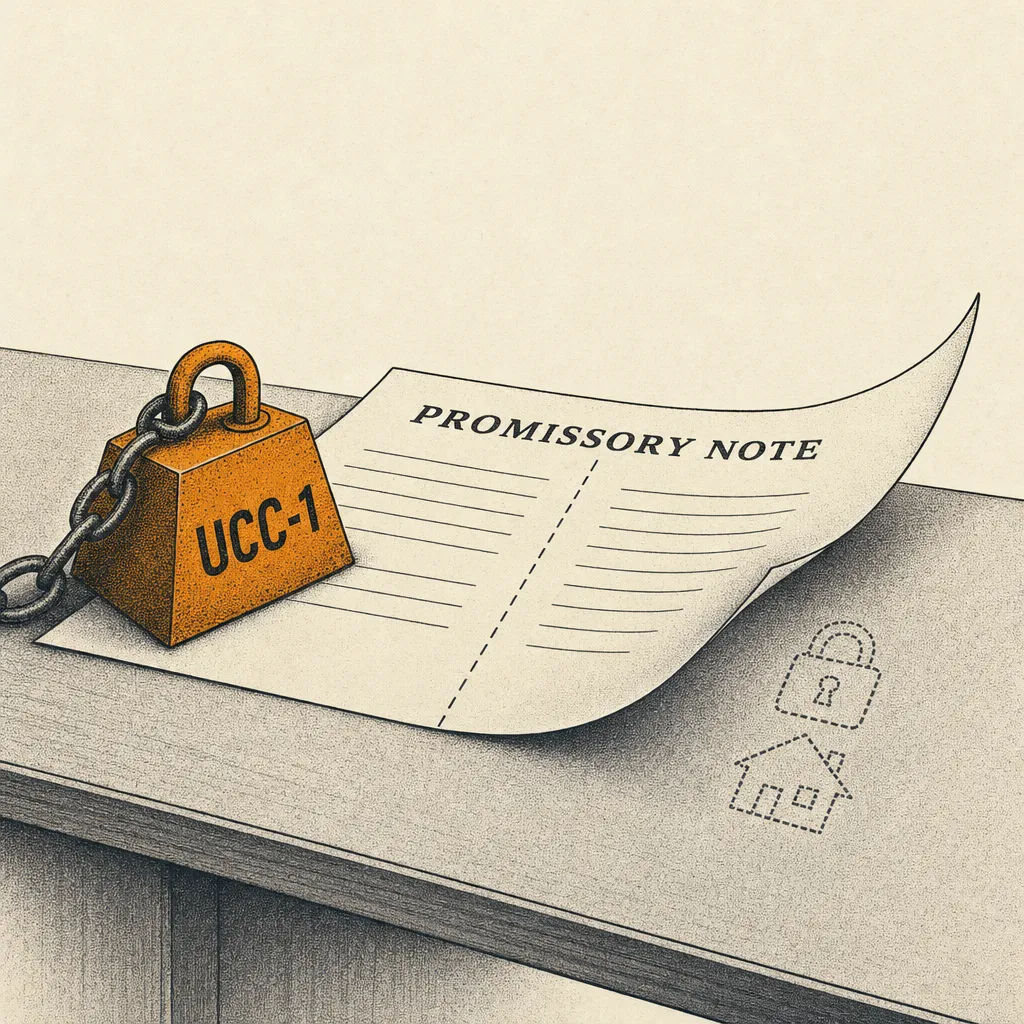
Security and collateral. The note must be secured by the agency assets. Without a security agreement and a perfected UCC-1 lien, the note is unsecured. A properly filed UCC-1 gives you a perfected security interest in the agency's assets, book of business, and receivables Morgan & Westfield.
-
Default and acceleration. The note spells out what constitutes a default and gives you the right to accelerate the full balance. Without an acceleration clause, you can only sue for missed payments individually. The cure period should be ten to thirty days for payment defaults, not ninety.
What Makes a Seller Note Actually Collectible?
The difference between a note that pays and one that does not comes down to four structural elements. Sellers who skip these to avoid friction with the buyer are the ones posting in M&A forums three years later asking how to collect a defaulted note.
Why Is a Personal Guaranty from the Buyer Principal Essential?
If the buyer entity is the only obligor on the note and the entity runs out of cash, you have nothing to pursue. A personal guaranty from the individual buyer principal means their personal assets, home equity, and investment accounts stand behind the note.
This is standard in transactions under $5 million. If the buyer refuses to sign one, treat that as a red flag. It means the buyer wants to protect personal assets from the very deal they are asking you to finance.
Why Must the UCC-1 Filing Happen Before Closing?
A UCC-1 financing statement publicly records your security interest in the agency assets. Without it, the buyer could sell the agency to a third party, pledge the same assets to a bank, or dissolve the entity, and you would have no perfected claim.
The filing must happen at or before closing. Most deal attorneys run the UCC search before closing to confirm no prior liens exist, file the UCC-1 on closing day, and send you confirmation within 48 hours.
How Do Operating Covenants Protect the Seller?
The note should include affirmative and negative covenants. Affirmative covenants include maintaining insurance on agency assets, providing quarterly financial statements, and notifying you of material changes. Negative covenants restrict selling substantial assets, incurring additional senior debt without your consent, and changing the entity structure.
These covenants give you an early-warning system. If the buyer stops providing quarterly financials in month 14, you know something is wrong before a payment is actually missed.
Why Does the Acceleration Clause Need a Short Cure Window?
The acceleration clause is what makes everything else credible. If the buyer misses a payment, you can declare the entire remaining balance immediately due after the cure period expires. A standard clause reads: "Upon any Event of Default that is not cured within 15 calendar days of written notice, Holder may declare the entire unpaid principal balance plus accrued interest immediately due and payable."
Without it, you can only sue for each missed payment individually over years. The buyer can string you along while the agency deteriorates. An acceleration provision collapses the timeline and gives you real negotiating leverage.
How Does IRS Section 453 Drive the Note Structure?
IRC Section 453 governs installment sales. Under the installment method, you report gain only as principal payments are received, not all in the year of sale IRS Publication 537. A gross profit ratio calculated once at closing applies to every principal payment.
Example: an agency sells for $2 million with a $200,000 basis and $100,000 in selling expenses. Gross profit is $1.7 million, ratio is 85 percent. On a $400,000 principal payment, you recognize $340,000 in gain and recover $60,000 of basis. Interest income gets taxed separately on Schedule B.
Two traps to avoid.
First, depreciation recapture is not deferrable. Under IRC Section 453(i), Section 1245 or 1250 recapture must be recognized in full in the year of sale regardless of when cash arrives IRS Publication 537.
Second, the Section 453A interest charge applies when outstanding installment obligations exceed $5 million at year-end CT Acquisitions IRC 453 Guide. For sales under $5 million, unlikely to trigger. If you carry a $3 million note, model the charge with your CPA.
The AFR sets the floor on interest. If the seller note carries a rate below the IRS Applicable Federal Rate, the IRS imputes interest and recharacterizes part of each principal payment as interest income IRS Applicable Federal Rates. As of mid-2026, mid-term AFRs sit in the 4.0 to 4.5 percent range, so a note at 6 to 7 percent clears easily.
What Happens with an SBA Loan on Top of the Seller Note?
Many agency acquisitions layer an SBA 7(a) loan on top of the seller note. Under SBA SOP 50 10 8, a seller note counted toward the buyer's equity injection must be on full standby for the entire SBA loan term, meaning zero payments to the seller while the SBA loan is outstanding. If not on full standby, it can still be part of the structure but will not count toward equity Pioneer Capital Advisory.
The documentation includes a promissory note, a subordination agreement, and SBA Form 155, which formalizes senior repayment rights and stops seller payments if the SBA loan enters default.
The key negotiation is full standby versus partial (interest-only after a defined period). Partial standby favors the seller but is harder to get approved. Two implications: with a 10-year SBA term and full standby, the seller collects nothing until year 11. And if the SBA lender forecloses, the seller note gets wiped. Sellers in SBA-layered deals should push for a larger down payment to compensate.
What Is the Operator's Take on Seller Note Negotiation?
Most sellers spend their energy on the multiple and gloss over the note terms. That ratio is backward. Per Morgan & Westfield, seller-financed deals command a 20 to 30 percent premium over cash sales, but that premium is only real if the note actually collects.
The acceleration clause, UCC-1, and personal guaranty are not aggressive asks. They are standard in every professionally structured M&A deal. A buyer who pushes back on all three is either uninformed or plans to test your willingness to enforce. Either way, walk.
The note structure is the collection mechanism. Get it right before closing, because there is no fixing a broken note after the wire clears.
Frequently Asked Questions
What interest rate should a seller carryback note carry?
Market rate for seller notes ranges from 6 to 8 percent Morgan & Westfield. The rate must sit above the IRS AFR to avoid imputed interest. A 7 percent coupon on a 5-year note is common.
How much should the buyer put down on a seller-financed agency sale?
Morgan & Westfield recommends a minimum of 30 to 50 percent. Anything below 30 percent carries elevated default risk. On a $2 million sale, that means $600,000 to $1 million cash at close.
Can I sell my seller carryback note for cash later?
Yes, seller notes sell on the secondary market at a discount. A performing note with a strong buyer behind it might sell at 85 to 95 cents on the dollar. A note with weak documentation sells at a steeper discount or not at all.
What happens if the buyer files for bankruptcy after closing?
Your recovery depends entirely on a perfected security interest. A UCC-1 lien places you as a secured creditor ahead of unsecured creditors. Without it, the note is an unsecured claim and you recover pennies on the dollar.
Is a seller carryback note worth it behind an SBA loan?
Only if the down payment offsets the subordination risk. A full-standby seller note behind a 10-year SBA loan means zero payments for a decade. Negotiate partial standby, push the down payment above 40 percent, or shorten the note term to match the earliest realistic exit.
Sources
- IRS Publication 537 - Installment Sales (2025)
- IRC Section 453: 2026 Installment Sale Tax Mechanics - CT Acquisitions
- M&A Seller Financing: A Complete Guide - Morgan & Westfield
- 2024 Insurance M&A Transactions - Sica Fletcher
- Insurance Brokerage M&A Stays Active in 2025 - MarshBerry
- Seller Financing in SBA 7(a) Acquisitions - Pioneer Capital Advisory
- IRS Applicable Federal Rates
Related Reading
Calculate Your Carryback Savings
Get Started →Written by licensed property and casualty agency operators on the Insurance Dudes M&A Desk. Insurance Agency Trader is US-based, serving independent and captive agency owners across the United States.
Editorial process: every post is reviewed against our published valuation math and current market data before it ships, and updated when the numbers move. Corrections: email craig@insuranceagencytrader.com and we will fix errors promptly.