Protecting Your Agency Book With a Non-Piracy Agreement
A non-piracy agreement stops departing producers taking your agency's book of business and protects its sale value. See what it covers and why buyers check.
A non-piracy agreement stops a departing producer from taking your agency's clients to a new agency for a set period, and it is the first document a buyer checks in due diligence. It is narrower than a non-compete, so courts favor it, but enforceability still turns on state law and reasonable scope. Unsigned producers mean a lower sale price.
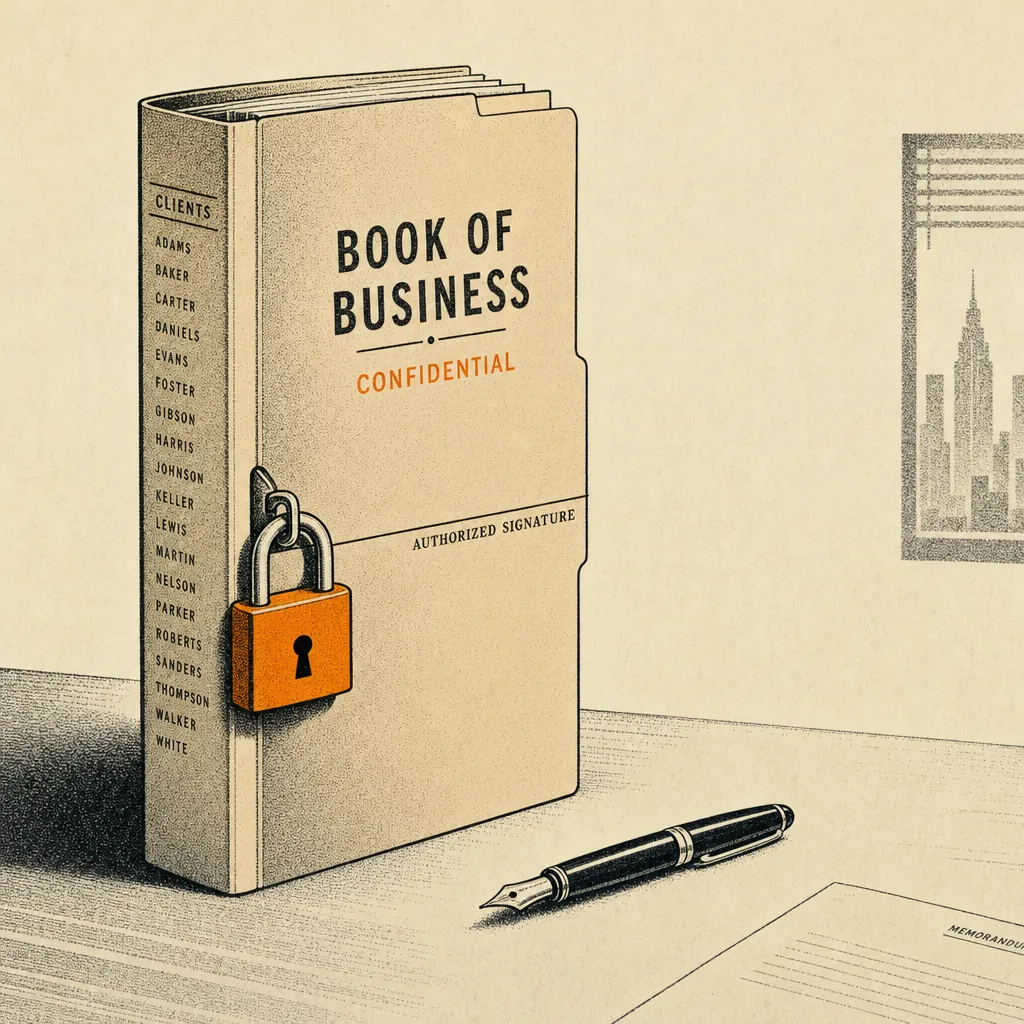
A non-piracy agreement is the document that decides whether you own your book of business or just rent it. If a producer can walk out the door and take their clients with them, the value of your agency shrinks the moment a buyer asks to see the paperwork, and a non-piracy agreement is nearly always the first covenant a buyer reviews in diligence.
Key Takeaways
- A non-piracy agreement stops a departing producer from selling to or taking your agency's clients for a set period, but it does not stop them from selling insurance somewhere else.
- Courts look more favorably on non-piracy covenants than on geographic non-competes, which are routinely struck down for overreach.
- The agreement must be signed at the start of the relationship, because most states require it to be in place when the producer joins.
- California voids most of these covenants under its Business and Professions Code, so the state your producers sit in drives enforceability.
- A book of business without signed non-piracy agreements is what buyers call a diligence item that can kill a deal.
What is a non-piracy agreement and how is it different from a non-compete?
A non-piracy agreement is a restrictive covenant that limits a departing producer from soliciting or accepting the insurance business of clients they serviced while employed at the agency. The definition that matters, per Agency Consulting Group, is a prohibition for a set period on a former employee "assuming or accepting" the insurance products of the agency's clients, or influencing clients to move to another insurance entity, or accepting remuneration tied to those clients. Notice the phrase "assuming or accepting," which goes further than a simple ban on soliciting and blocks a producer from quietly becoming the client's agent after the fact (agencyconsulting.com).
The difference from a full non-compete is the whole point. A traditional non-compete forbids an employee from competing in a geographic area for a time, and because those geographic terms are often written too broadly, courts routinely invalidate the entire agreement (agencyconsulting.com). A non-piracy covenant drops the geography and instead targets the one thing the agency actually cares about: keeping a producer from taking the specific customers they knew. BoyarMiller frames it plainly: an insurance agency generally is not trying to stop a former producer from selling insurance altogether, it just wants to keep them from taking the agency's customers when they leave (boyarmiller.com).
Why is a non-piracy agreement the first thing a buyer checks in diligence?
Because the loyalty of the customer often runs to the producer, not to the agency name. BoyarMiller's guidance is blunt: owning an insurance agency without every producer and CSR subject to a non-piracy agreement is "akin to renting a business rather than owning it," and a buyer's first diligence request is to see those agreements. If they are missing, the transaction is immediately at risk while the seller scrambles to convince a buyer the book is stable (boyarmiller.com).
The economics make the exposure concrete. If a key producer can leave with their business, both the annual income and the purchase price drop, because the price a buyer will pay reflects the stability of the book as much as its size. The same point shows up in the trade press: non-piracy agreements are less onerous to employees and are usually viewed more favorably by courts than traditional non-competes, which is exactly why a well-drafted one protects the owner's legitimate interest in the book its agents produced (insurancejournal.com).
Are non-piracy agreements enforceable, and what makes one hold up?
Enforceability is governed by state law and varies considerably, which is the single most important thing to know before you rely on one. The Legal Information Institute at Cornell is explicit that whether conduct counts as solicitation and whether a covenant is valid "depends on the agreement's language and the governing law in that particular jurisdiction," and that a court weighs duration, scope, and whether the restriction is broader than necessary to protect a legitimate interest (law.cornell.edu).
The state split is stark. California's Business and Professions Code broadly voids contracts that restrain a person from a lawful profession, and a California Court of Appeal has held a broadly worded employee non-solicitation provision void for exactly that reason. Louisiana, by contrast, legislates a carve-out: Louisiana Revised Statutes Section 23:921 permits customer non-solicitation restrictions in business-sale and employment agreements when the covered parishes or municipalities are named and the term runs no more than two years (law.cornell.edu). A buyer cannot assume a seller's Texas or New York covenant travels to California.
A covenant that survives is reasonable as to duration, territory, and scope, and it is signed when the producer is hired, because in most instances the law requires the agreement be in place at the beginning of the relationship. Trying to impose one on a producer who has already decided to leave is nearly always too late (boyarmiller.com).
What does the shifting non-compete landscape mean for a non-piracy covenant?
Non-piracy and non-solicitation covenants are narrower than non-competes, and that distinction has only gotten more valuable as the federal non-compete rule has risen and fallen. The Federal Trade Commission adopted a final rule in April 2024 that would have banned most new employer-worker non-competes nationwide, subject to a carve-out for non-competes entered into as part of the sale of a business and for preexisting senior-executive agreements (federalregister.gov).
That rule never took effect. A district court set it aside in 2024, and in 2026 the FTC formally removed the non-compete rule from its regulations to conform to the court decisions, which the Federal Register documents under the agency's 2024 rulemaking history (federalregister.gov). The practical takeaway for an agency deal is not to lean on a federal ban that no longer exists. It is that a tightly drawn non-piracy covenant, which does not stop someone from working or selling insurance, sits in the category courts treat more favorably than a full non-compete. That is the instrument that has to do the protecting.
Frequently Asked Questions
Does a non-piracy agreement stop a client from following the producer?
No. The client is free to move their business anywhere, including to the departed producer's new agency. The agreement restrains the producer from soliciting or accepting that business for the covered period, not the client's right to choose (agencyconsulting.com).
When should a non-piracy agreement be signed?
When the producer is hired, not when they resign. The law in most instances requires the agreement be in place at the beginning of the relationship, and it is far harder to impose protection once a producer has decided to leave (boyarmiller.com).
Is a non-piracy agreement the same as a non-disclosure agreement?
They overlap but are not the same. A good non-piracy covenant should be paired with a strong confidentiality and non-disclosure clause, because most states also recognize a common-law duty to protect proprietary information, and the written agreement makes that duty specific (boyarmiller.com).
What if my producers are in a state like California?
Then you should not assume the covenant is enforceable. California's Business and Professions Code has been applied to void broadly worded non-solicitation provisions, so enforceability in that state is heavily fact-specific and should be assessed with counsel before you price the deal on it (law.cornell.edu).
What would we actually do about a book full of unsigned producers?
This is a boring covenant that quietly sets your sale price. Buyers check it first because they know the client usually belongs to the producer, not the name on the door, and a book with no signed non-piracy agreements is a book they will discount or walk away from (boyarmiller.com). If you are a captive owner sitting on a book your producers service day to day, the move is to get every producer and CSR under a reasonable, state-specific non-piracy covenant now, while the relationship is fresh, not the week before you list. The difference between renting your book and owning it is a signature you cannot go back and collect later.
Sources
- Effective Non-Piracy Agreements Protect Your Business - BoyarMiller
- Non-Compete and Non-Piracy - Agency Consulting Group
- Nonsolicitation agreement - Wex, Legal Information Institute, Cornell
- Removal of the Non-Compete Rule - Federal Register
- Why Risk It - Insurance Journal
Related Reading
Calculate Your Agency Value
Get Started →Written by licensed property and casualty agency operators on the Insurance Dudes M&A Desk. Insurance Agency Trader is US-based, serving independent and captive agency owners across the United States.
Editorial process: every post is reviewed against our published valuation math and current market data before it ships, and updated when the numbers move. Corrections: email craig@insuranceagencytrader.com and we will fix errors promptly.