How Insurance Agency Roll-Ups Build Value Post-Acquisition
How insurance agency roll-ups create value post-acquisition: the consolidator playbook for multiple arbitrage, integration, cross-selling, and retention.
Insurance agency roll-ups succeed or fail on post-acquisition integration, not deal volume. Consolidators who build shared services, retain producers and books, and execute cross-selling create the multiple expansion that justifies the purchase price. Those who stop at the LOI and neglect integration find that scale without execution is just overhead.
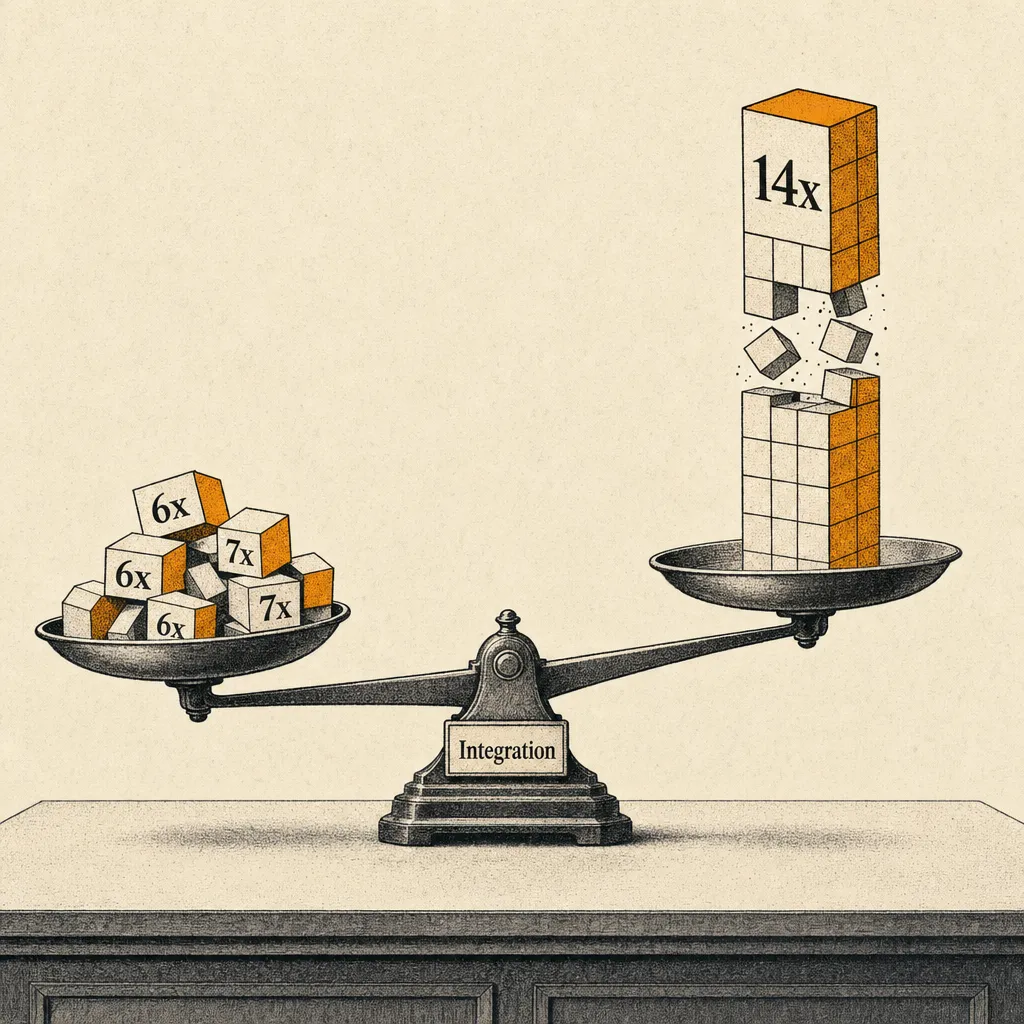
The consolidator playbook is simple on paper: buy agencies at 6x to 8x EBITDA, bolt them onto a platform, and exit at 11x to 14x. The spread is what private equity calls multiple arbitrage, and it has driven over 80% of insurance brokerage M&A transactions in 2024 and the first half of 2025. But the arbitrage math only works if the consolidated entity actually performs after close. The spread between what you pay and what you sell for collapses if the acquired book walks, the producer quits, or the promised synergies never materialize.
Key Takeaways
- PE-backed consolidators accounted for over 80% of insurance brokerage M&A in 2024 through mid-2025, with 695 total agency deals in 2025 per OPTIS Partners
- Post-acquisition integration has replaced deal volume as the primary value driver; buyers now prioritize operational fit over speed
- Book retention, producer non-compete enforcement, and cross-selling are the three levers that move a consolidated agency from a 6x entry multiple toward a 14x exit multiple
- The valuation gap between well-integrated platforms and loosely assembled portfolios is widening as financing costs stay elevated
- Consolidators who skip integration and rely on multiple arbitrage alone are now trading at a discount as the buyer pool shrinks
How does a roll-up actually create value?
The private equity roll-up playbook in insurance distribution follows a three-stage cycle. First, a PE firm acquires a platform agency: a mid-market brokerage with strong management, diversified revenue, and the infrastructure to absorb add-on acquisitions. That platform becomes the hub. Second, the platform acquires smaller agencies, typically at lower EBITDA multiples than the platform itself commands. Third, after a hold period of three to seven years, the combined entity is sold or recapitalized at the platform's higher multiple.
The spread is the profit engine. Sica Fletcher's 2025 dataset of over 450 sell-side transactions places the average adjusted EBITDA multiple for agencies with $1 million-plus EBITDA at approximately 11.8x. Small personal-lines books trade at 5x to 7x. The same book, folded into a $10 million EBITDA platform with an 11x to 14x multiple, is worth roughly twice as much purely on rerating. That is the arbitrage.
But PwC's 2026 midyear insurance deals outlook flags a crack: moderating premium rate increases and AI-driven disruption are compressing distributor valuations, narrowing the spread consolidators rely on. Higher-for-longer interest rates make debt-funded acquisitions more expensive. The firms still earning the spread are generating real operational lift, not just buying revenue.
Why are consolidators shifting from deal volume to integration quality?
Through May 2026, there were 241 US insurance brokerage M&A transactions, down 5.1% from the same period in 2025. The top three buyers (BroadStreet Partners, Inszone, and ALKEME) accounted for 30.7% of all deals. Private capital-backed buyers represented 70.5% of the market. The concentration is telling: a handful of well-capitalized consolidators are still active, but they are buying differently.
MarshBerry describes the shift in explicit terms: "value creation is no longer driven primarily by acquisition volume, but by the quality of integration". Buyers are placing dedicated integration teams and technology infrastructure at the center of their capital allocation decisions, not as an afterthought. The reasoning is straightforward: cultural fragmentation, missed cross-selling opportunities, and producer departures destroy the multiple expansion that makes the roll-up math work.
This is a structural change, not a cyclical one. With OPTIS Partners reporting 695 agency deals in 2025, down 12% from 787 in 2024, the market is settling into a steady-state consolidation rhythm rather than an accelerating land grab. Q4 2025 recorded just 157 deals, the lowest fourth quarter since 2019 and 47% below the five-year average. The consolidators left standing are the ones who can extract value from what they already own.
What are the actual value creation levers?
Consolidators build post-acquisition value across five interconnected categories. Each lever compounds the next, and the difference between a 7x exit and a 14x exit is how many of them actually fire.
Book retention is the first domino. At 90% retention, roughly nine expected renewals per policy; at 85%, fewer than six. Every point of retention lost after close represents commission the buyer paid for but never collected. Earn-outs and holdbacks protect against retention failure but do not create multiple expansion. They limit damage. Buyers structure contingent payments around three-year retention targets, with strong agencies clearing higher upfront cash and shorter earn-out periods.
Producer retention is second and closely tied to the first. In many smaller agencies, the owner is the top producer, and the book walks if they walk. Post-acquisition producer agreements with multi-year retention bonuses, platform equity, and clear career tracks are the standard play. Without them, the buyer bought a phone number and a lease.
Cross-selling is where the platform model justifies itself. A standalone agency with an 80% personal-lines book has limited cross-sell surface area. That same book folded into a platform with a commercial practice, life insurance desk, and benefits division can layer additional policies onto every household. MarshBerry notes that smart consolidators prioritize "specialization" and "complementary capabilities" when selecting targets, not just revenue scale.
Shared services are the cost-side lever. Centralizing accounting, HR, carrier relations, and technology procurement across acquired agencies compresses operating costs and improves the combined EBITDA margin. But Oswald Companies' pooled insurance model across 23 portfolio companies shows the next phase: creating capabilities at the portfolio level no single acquired agency could build alone, not just eliminating back-office redundancy.
Technology and data integration is the emerging accelerator. Consolidators who unify agency management systems, CRM data, and client records can surface cross-sell triggers, identify retention risks before policies lapse, and run analytics that standalone agencies cannot afford. The Fall Line Specialty analysis frames this as "operationalizing intelligence for competitive advantage", and firms developing sophisticated data capabilities are pulling ahead.
What breaks a roll-up?
Three failure patterns recur across consolidation plays that stall.
First, the platform buys agencies it cannot integrate. Different management systems, incompatible carrier codes, and separate brand identities create a portfolio of fiefdoms rather than a unified business. The platform multiple never attaches because the platform never actually forms. A buyer who treats integration as a post-close checklist item rather than the core strategy is buying revenue at retail and hoping to sell it at wholesale.
Second, producers leave. Post-acquisition, the non-compete is only as strong as the employment agreement and the state law that governs it. If the acquiring platform strips autonomy, changes compensation unexpectedly, or fails to deliver on cross-selling infrastructure, the producer walks at the end of the retention period and the book follows.
Third, the financing model breaks. Elevated borrowing costs mean debt-heavy roll-up strategies carry thinner margins. PwC notes that narrowing valuation spreads directly impact "acquisition capital available to consolidators", and some buyers are stepping back entirely. The firms that remain active are those with permanent capital, strong cash flow, and the discipline to walk from overpriced targets.
Frequently Asked Questions
What is an insurance agency roll-up?
A roll-up is a consolidation strategy where a platform company acquires multiple smaller agencies and integrates them into a single operating entity. The goal is to capture the spread between the lower multiples paid for small agencies and the higher multiples large platforms command at exit.
How do consolidators value insurance agencies?
Consolidators value agencies primarily on adjusted EBITDA, with the mid-market band running 11.4x to 11.8x for agencies above $1 million EBITDA. Personal-lines-heavy books trade at 5x to 7x, while specialty and benefits-led books can reach 12x to 14x. Book retention rate is the single largest swing factor, with each point below 90% compressing the multiple by meaningful increments.
What is multiple arbitrage in insurance M&A?
Multiple arbitrage is buying smaller agencies at lower EBITDA multiples, typically 6x to 8x, and selling the combined entity at the higher multiples large platforms command, typically 11x to 14x. The spread is the profit, but it only materializes if the consolidated entity performs at the level implied by the exit multiple.
Why is post-acquisition integration more important than deal volume now?
With financing costs elevated and organic growth moderating, buyers can no longer rely on rising valuations alone to generate returns. Integration quality directly impacts book retention, producer stability, and cross-selling execution. Consolidators with better integration capabilities command wider valuation premiums, creating a self-reinforcing advantage loop.
How long does it take a consolidator to build value post-acquisition?
Most PE-backed consolidators operate on a three-to-seven-year hold. The first 12 to 18 months focus on system integration, producer retention, and client communication. Years two through four center on cross-selling and margin improvement. Years four through seven target exit preparation. Platforms that skip integration in year one typically never hit the exit multiple the model assumed.
Sources
- MarshBerry, "Insurance Brokerage M&A Remains Resilient But With Signs Of Recalibration" (June 2026)
- MarshBerry, "From Deal Volume To Deal Quality: Integration As The New M&A Advantage" (May 2026)
- Insurance Journal, "Pace of Insurance M&A Lagged in 2025 With No Mad Dash: OPTIS" (January 2026)
- PwC, "US Deals 2026 Midyear Outlook: Insurance" (June 2026)
- Ad Astra Equity / Sica Fletcher, "Insurance Agency Valuation & EBITDA Multiples" (June 2026)
- Forbes, "Insurance Agency M&A: Strike Before The Market Cools" (October 2024)
- Fall Line Specialty, "AI at the Helm: How Private Equity Insurance Roll-Ups Are Evolving in 2025" (December 2025)
Related Reading
- /blog/insurance-agency-revenue-multiples-2026
- /blog/insurance-agency-ebitda-explained
- /blog/independent-agency-m-and-a-pipeline
What should an acquirer actually do differently?
A roll-up that buys revenue and ignores integration is just a debt-loaded collection of agencies wearing the same logo. The firms winning right now are the ones running a real shared operating model: central services, career paths for producers, a CRM that talks across the portfolio, and a retention strategy that starts the day the LOI is signed, not the day the book starts leaking. If you are buying your first bolt-on, build the integration playbook before you close. The multiple spread only prints if the combined business actually performs, and the spread is getting thinner. The consolidators who survive the next five years will be the ones who treat integration as their product, not their post-close project.
Value Your Agency
Get Started →Written by licensed property and casualty agency operators on the Insurance Dudes M&A Desk. Insurance Agency Trader is US-based, serving independent and captive agency owners across the United States.
Editorial process: every post is reviewed against our published valuation math and current market data before it ships, and updated when the numbers move. Corrections: email craig@insuranceagencytrader.com and we will fix errors promptly.