Captive vs Independent: Which Book Sells for More?
Independent P&C agencies sell for 10 to 30 percent more than captive agencies. Ownership structure, carrier flexibility, and transfer ease drive the gap.
Independent P&C agencies sell for 10 to 30 percent more than captives at the same revenue. Captives carry structural discounts on expirations ownership, carrier-controlled transfer, and a thinner buyer pool. The valuation gap on a $500K book typically runs $100K to $300K.
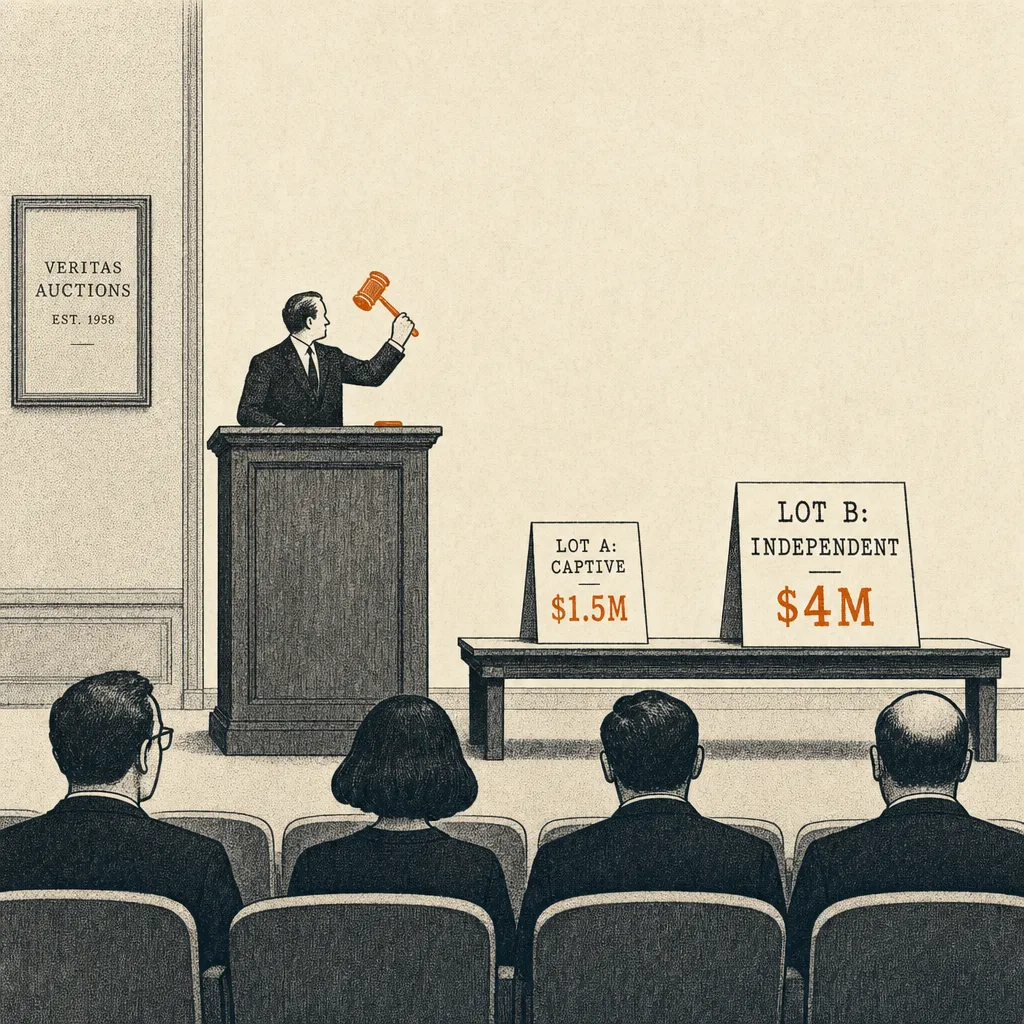
In our marketplace experience, independent P&C insurance agencies typically sell for 10-30% more than captive agencies (State Farm, Allstate, Farmers, etc.) with comparable revenue. The exact gap varies by carrier, region, and deal specifics rather than holding to a fixed percentage. A $500,000 captive agency might sell for 1.2x-1.5x revenue ($600K-$750K), while a $500,000 independent agency could command 1.5x-2.0x revenue ($750K-$1M). The difference comes down to ownership structure (captive agents don't fully own their expirations), transfer risk (carrier must approve the buyer) and strategic flexibility (independent agents can move clients between carriers).
If you're a captive agent planning to sell, understanding this valuation gap and your options, can mean the difference between leaving $100K-$300K on the table or capturing full market value.
The data backs this up: MarshBerry reports that independent firms with strong profitability trade at multiples ranging from the mid-single digits to mid-teens, while captive books face structural discounts due to carrier-controlled ownership of expirations and transfer approval requirements.
Why Do Independent Agencies Sell for More Than Captive Agencies?
Reason 1: What Does True Ownership of Expirations Mean for Valuation?
Independent agencies:
- The agent owns the expirations outright
- Clients are your property, not the carrier's
- You can sell the book to any qualified buyer
- No carrier approval required (beyond routine appointment transfers)
Captive agencies:
- The carrier owns the expirations (technically)
- You have the right to service and collect commissions
- But if you leave the carrier, the expirations stay with the carrier
- Sale requires carrier approval (they control the transfer)
Impact on valuation:
Buyers pay a premium for certainty of ownership. With an independent agency, the buyer knows they're purchasing an asset they fully control. With a captive agency, the buyer is purchasing a conditional right to service that the carrier can revoke.
Example:
- Independent $500K agency: Valued at 1.7x = $850K
- Captive $500K agency: Valued at 1.4x = $700K
Difference: $150K for the same revenue, solely due to ownership structure.
Reason 2: How Does Carrier Flexibility Lift an Independent's Multiple?
Independent agencies can:
- Move clients between carriers based on pricing, service, claims experience
- Drop underperforming carriers and add better ones
- Negotiate commission rates across multiple carriers
- Diversify carrier relationships to reduce concentration risk
Captive agencies are locked in:
- Single carrier (State Farm, Allstate, etc.)
- If the carrier raises rates too high, you lose clients, but can't move them
- If the carrier cuts commissions, you have no recourse
- If the carrier exits a market, your book dies
Impact on valuation:
Buyers value optionality. An independent agent can adapt to market conditions. A captive agent is at the mercy of one carrier's decisions.
Real-world example:
- In 2023-2024, State Farm and Allstate pulled back from California and Florida homeowners markets
- Captive agents in those states lost huge portions of their books
- Independent agents moved clients to surplus lines carriers and preserved revenue
Buyers see this risk and discount captive agencies accordingly.
Reason 3: Why Does Easier Transfer Translate to a Higher Sale Price?
Independent agency transfer process:
- Buyer and seller agree on terms
- Carrier appointments are transferred (routine process)
- CRM and client files handed over
- Transition period (30-90 days)
- Done
Captive agency transfer process:
- Buyer and seller agree on terms
- Seller submits transfer request to carrier (carrier decides if they approve)
- Buyer must meet carrier's requirements (minimum production, licensing, training, financial stability)
- Carrier interviews the buyer (vetting process can take 30-90 days)
- Carrier approves or denies the transfer (denial kills the deal)
- If approved, CRM and files handed over
- Transition period
Impact on valuation:
The extra steps and the risk of denial, add uncertainty and time to the transaction. Buyers discount captive agencies to account for this friction.
In practice, captive transfers involve more steps and take longer than independent transfers due to carrier vetting requirements. Specific timelines and approval rates vary by carrier and are not publicly disclosed, consult your carrier's agent transfer documentation for details.
Reason 4: How Does a Bigger Buyer Pool Drive Up Independent Multiples?
Independent agencies:
- Any licensed P&C agent can buy (regardless of current carrier relationships)
- Bigger buyer pool = more competitive offers = higher sale price
Captive agencies:
- Buyer must be approved by the carrier
- Often, the carrier prefers internal candidates (existing agents in the system)
- External buyers face higher hurdles
- Smaller buyer pool = less competition = lower sale price
In our marketplace experience, captive listings attract fewer buyer inquiries than comparable independent listings, in part because many prospective buyers self-select out due to carrier approval uncertainty.
Fewer buyers = weaker negotiating position for the seller.
The Captive Valuation Penalty: How Much?
MarshBerry reports that independent firms with strong profitability trade at multiples ranging from the mid-single digits to mid-teens (EBITDA-based), while Peak Business Valuation documents revenue multiples of 1.82x-2.33x for insurance agencies generally. Captive books face structural discounts because of ownership limitations and transfer friction, though the exact discount varies by carrier, region and deal specifics.
The general pattern: Independent agencies command higher multiples because the buyer is purchasing a fully transferable asset. Captive agencies trade at a discount because the buyer is purchasing a conditional right that requires carrier approval.
What Do Captive Agents Need to Know About Their Carrier Before Selling?
Transfer processes and restrictions vary significantly by carrier. There are no publicly available "transfer approval rates", each carrier handles agent transitions differently and the terms are governed by your specific agent agreement.
What the data does tell us:
Allstate's agent count has dropped to just 8,400, down from 9,300 a year prior and 10,400 two years ago, according to SEC filings reported by Insurance Business Magazine. Allstate agents accounted for only 38% of new auto policies in 2022, down from 71% in 2020.
"Allstate agents are contracted to sell and service Allstate Insurance policies... unlike true independent contractor insurance agents, captive Allstate agents are prohibited from performing their profession with any other insurance carrier." NAPAA (National Association of Professional Allstate Agents), Attorney General Letter
Farmers has been cutting base commission rates "for most products" while restructuring its agent distribution model, prompting what agents on Indeed describe as "commissions reduced to the point of theft."
State Farm agents operate under a unique model: agents are independent contractors but do not own their expirations in the way independent agents do. This distinction, between owning a book of business and owning a real business, is explored in depth in You Own Your Book, Not Your Business. When a State Farm agent retires or exits, the book is handled through State Farm's internal process, it cannot be sold on the open market to any buyer. Per Insurance Business Magazine, State Farm controls the assignment of books to new or existing agents.
If you're captive, read your carrier agreement carefully and consult an attorney BEFORE you list or consider any transition.
Can You Switch to Independent Before Selling?
Some captive agents consider transitioning to independent before selling to capture higher multiples. This is a complex decision with significant legal and contractual implications, it is not a simple "play." Our step-by-step guide to going independent after ten years captive walks through the realistic timeline and financial trade-offs.
What Are the Critical Warnings Before Switching to Independent?
Most captive agent contracts include non-compete and non-solicitation clauses that restrict what you can do during and after your transition. Violating these clauses can result in:
- Loss of all renewal commissions and deferred compensation
- Legal action from your carrier
- Inability to solicit or contact your former clients for 1-2 years
- Financial penalties outlined in your contract
Non-compete enforceability varies significantly by state. California prohibits them entirely, while states like North Carolina have upheld Allstate's enforcement of non-solicitation agreements. The FTC's proposed ban on non-compete agreements (April 2024) remains in legal limbo, though non-solicitation agreements are explicitly excluded.
According to Pacific Crest Services, agents considering a captive-to-independent transition should start by having an attorney review their specific carrier contract, because the terms, restrictions and financial consequences vary dramatically between carriers and states. For a deeper walkthrough of what these clauses actually restrict, see our guide to captive agent non-compete clauses.
What Should You Verify Before You Consider Switching?
- Read your agent agreement cover to cover, know your non-compete radius, duration and non-solicitation terms
- Consult an attorney who specializes in insurance agency contracts in your state
- Understand what you forfeit, many captive contracts include deferred compensation, retirement commissions or bonuses you lose upon termination
- Assess your client relationships honestly, even without a non-solicitation clause, brand-loyal captive clients may not follow you
- Calculate the real cost, lost commissions during transition, new E&O insurance, carrier appointment timelines and potential client churn
This is not a decision to make based on a blog post. Get legal counsel specific to your carrier and state.
How Do You Maximize Sale Price If You Stay Captive?
If switching isn't an option, here's how to get the best price as a captive agent:
Strategy 1: How Do You Boost Retention Above 90 Percent?
High retention partially offsets the captive penalty. If your book is rock-solid, buyers will pay closer to independent multiples.
Target: 90%+ retention for 3 consecutive years
Strategy 2: How Do You Get Pre-Approval From the Carrier?
Before you list, ask your carrier:
- What are the buyer qualification requirements?
- Can you provide a list of pre-approved internal candidates?
- What's the typical approval timeline?
If you can show a buyer that carrier approval is "likely" (not "uncertain"), you reduce the risk premium.
Strategy 3: How Do You Find an Internal Buyer Inside Your District?
The easiest captive transfer is to another agent already in the carrier's system. They're pre-vetted, pre-trained and approval is near-certain.
Where to find internal buyers:
- Carrier agent networks (State Farm Agent Association, Allstate Agency Owner groups, etc.)
- Younger agents in your same carrier system looking to grow
- Adjacent territories (agent next door wants to expand)
Strategy 4: When Does Offering Seller Carryback Lift the Sale Price?
Seller financing partially offsets the captive penalty because:
- You expand the buyer pool (easier to qualify without a bank)
- Faster close (no bank underwriting on top of carrier approval)
- You earn interest income (compensates for the lower purchase price)
Example:
- Captive $500K agency priced at 1.3x = $650K (all-cash)
- Same agency with carryback financing = 1.4x = $700K
- You net $50K more by offering carryback
Strategy 5: Why Does Selling Sooner Beat Waiting for "Better" Conditions?
Captive agency valuations are declining over time as:
- Carriers pull back from unprofitable markets
- Direct-to-consumer competition intensifies
- Buyers become more sophisticated about ownership risk
If you're 55+ and thinking about selling in the next 5 years, list now. Valuations won't improve.
Frequently Asked Questions
Q: Do State Farm agents actually own their book?
A: State Farm agents are independent contractors, but their contract doesn't let them sell their book on the open market, assignment goes back through State Farm. That's structurally different from an independent agency and is the core reason captive books trade at lower multiples.
Q: What happens to my Allstate book when I leave?
A: Your book either transfers to an Allstate-approved buyer or you take the Termination Payment ("economic interest") calculated under your R3001 contract. Agents on forums consistently report the TPP formula pays less than a negotiated sale to an approved buyer which is why multi-year exit planning matters.
Q: Will I actually make more as an independent agent?
A: Most agents who transition report higher long-term income because multi-carrier close ratios and uncapped commissions outweigh the 12-18 month ramp. The first year often dips before the compounding kicks in, see our captive-to-independent transition guide for typical math.
Q: Is it worth switching carriers if I'm mid-career?
A: Agents under 55 with manageable non-solicit terms typically find the math favors switching, primarily because independent agencies eventually sell on EBITDA multiples instead of revenue multiples. Every situation is individual, review your contract with an insurance-specialized attorney before deciding.
What Should Captive Agents Take Away on the Valuation Gap?
The captive valuation gap is real, independent agencies generally command higher multiples due to ownership structure, transfer ease and buyer pool size. MarshBerry and Peak Business Valuation data confirm that independent agencies with strong profitability consistently trade at higher multiples than captive books.
For captive agents planning to sell:
- Maximize retention, high retention partially offsets the captive discount
- Get carrier pre-approval, reduce buyer uncertainty about the transfer process
- Find internal buyers, transfers within the carrier system face fewer hurdles
- Offer carryback financing, expand your buyer pool and close faster
- Consult an attorney before considering any transition to independent, your carrier contract governs what you can and cannot do
If you're independent, focus on retention, documented systems and deal structure to capture top-tier multiples.
Use our valuation calculator to see how your agency stacks up based on current market data.
Sources & References
- Insurance Business Magazine: Allstate Agent Count Drop
- NAPAA: Allstate Agent Classification
- Wallace Miller: Allstate Class Action
- The Insurer: Farmers Commission Cuts
- Insurance Journal: Allstate v. Robbins (NC) non-compete enforcement
- AgencyEquity: FTC Non-Compete Rule
- MarshBerry: Valuation Guide
Calculate your agency value now or explore your seller strategy options.
Get Your Agency Valuation
Get Started →Written by licensed property and casualty agency operators on the Insurance Dudes M&A Desk. Insurance Agency Trader is US-based, serving independent and captive agency owners across the United States.
Editorial process: every post is reviewed against our published valuation math and current market data before it ships, and updated when the numbers move. Corrections: email craig@insuranceagencytrader.com and we will fix errors promptly.